

Roadmapping for Government Innovation Policy
Summary
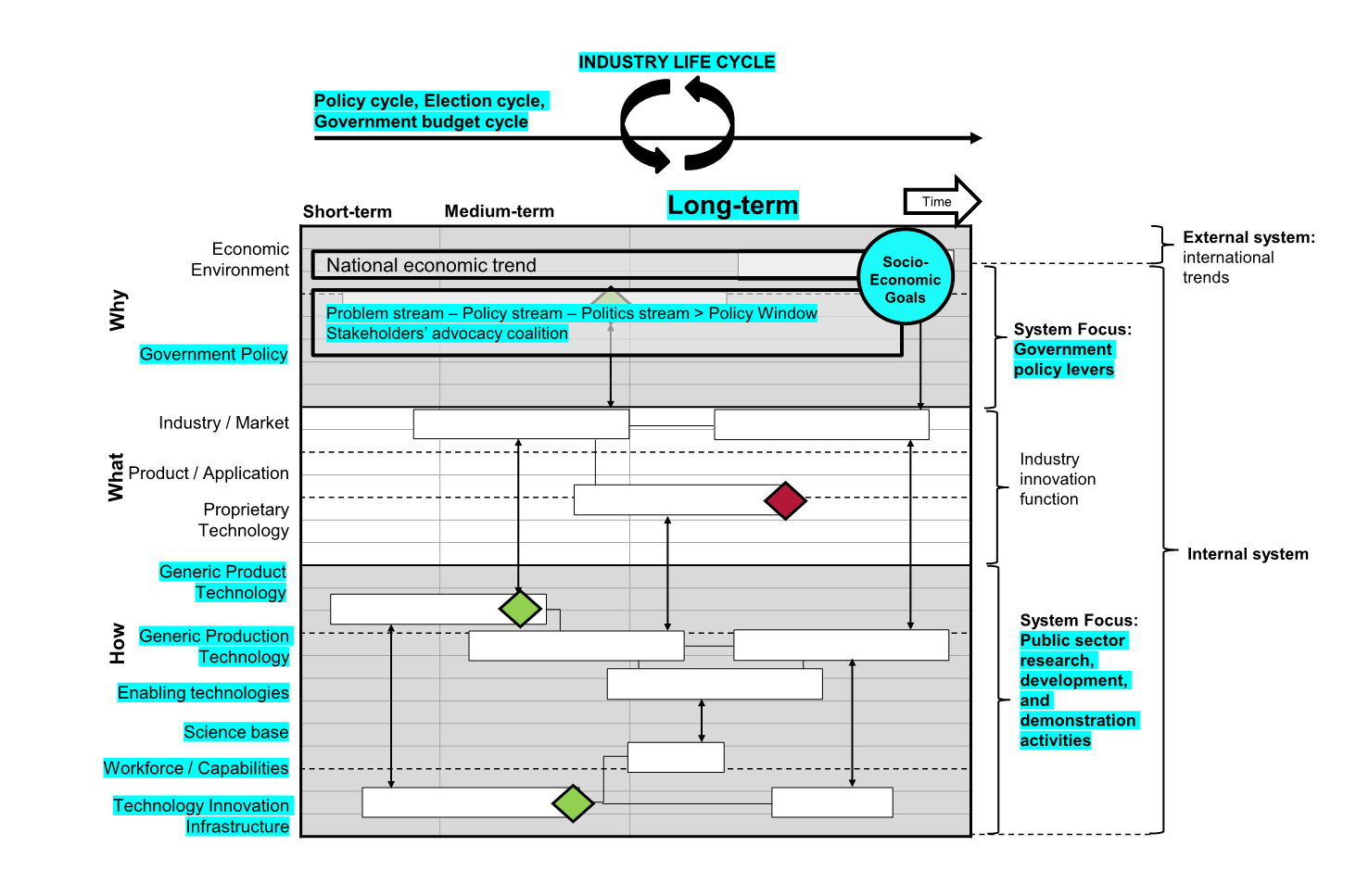
This project suggests that existing roadmapping approaches for government innovation policy should be reconfigured to explicitly incorporate public-good innovation layers in a clearer and more granular way. It proposes integrating four layers often overlooked in conventional approaches: the policy cycle, quasi-public-good technologies, technology innovation infrastructure, and workforce development. Including these elements enables a more accurate diagnosis of innovation system dynamics and the strategic levers available to policymakers.
Background
This research is primarily theory-building, developing an innovation policy roadmapping framework informed by interdisciplinary perspectives to create a more robust and policy-relevant model. To test and refine this framework, the project includes a longitudinal case study of the graphics processing unit (GPU), using an approach grounded in emergence mapping. The case study examines the long-term evolution of GPU innovation and the shifting public-good characteristics across its extended life cycles. Through narrative analysis, it reconstructs temporal sequences of key events and actor interactions based on textual evidence, which are then visually organised within the proposed framework.
The project aims to contribute a more comprehensive and analytically grounded approach to roadmapping for government innovation policy by developing a framework that better captures the complexity and public-good dimensions of technological change.
Contact: Yulisyah Putri Daulay