

Value Chain: Definitions
Value Chains
A broad definition of a value chain would be the interconnected set of firms and wider activities that together create the value added of the product. Each step in the sequence contributes to the overall value creation within the chain. Such a cumulative effect is particularly important to consider as it highlights that a rate-limiting factor in one step can lead to large losses in later steps, diminishing the overall value of earlier efforts. This perspective can thus help to identify activities that underpin the competitive advantage of firms, industries and economies. Depending on the industry, value chains could include R&D, design, raw materials processing, production, distribution, marketing, sales, after-sales services, recycling of products after use, etc. In the case of products, value chains often resemble a sequential (though not linear) process as each step builds on the next, while in the case of services, this can be conceived of as a network of processes.
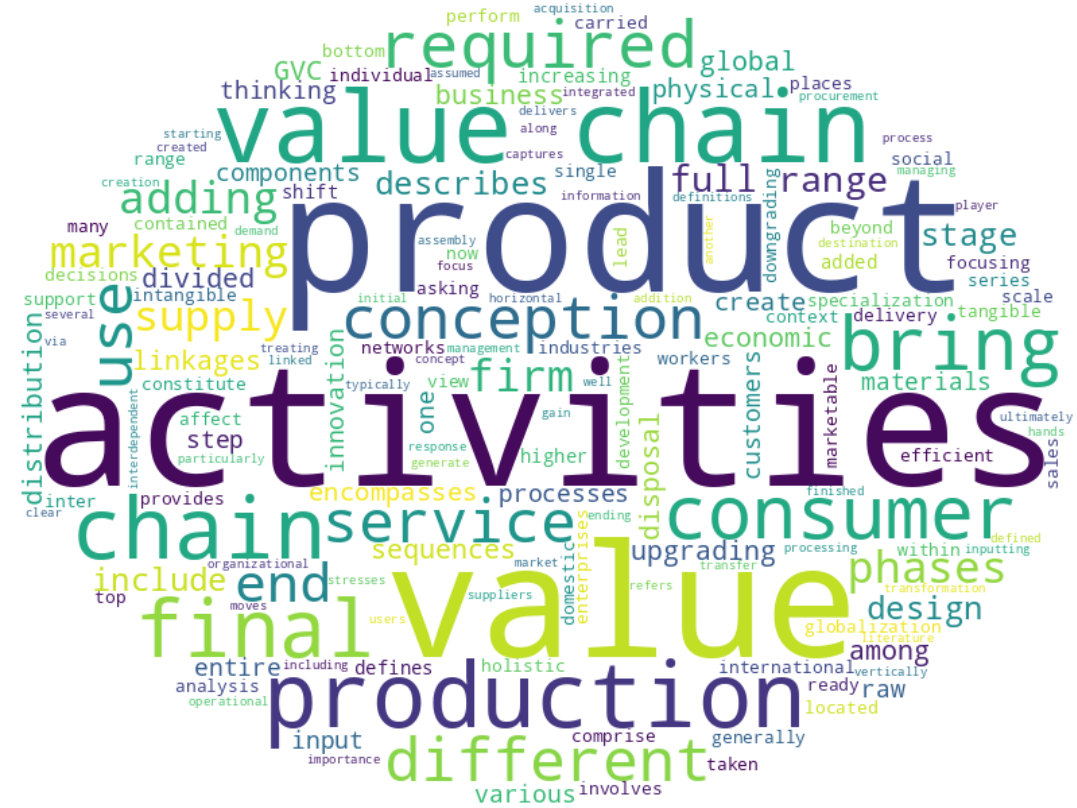
Figure 1. Word cloud of selected value chain definitions
The Distinction Between Value Chains and Supply Chains
The distinction between supply chains and value chains becomes critical once the analytical focus shifts from operational efficiency to economic outcomes. Supply chain perspectives tend to prioritise the continuity, reliability, and efficiency of input-output flows across firms, making them particularly useful for analysing trade exposure, resilience, and security-related risks. In this framing, performance is often assessed in terms of cost reduction, logistics optimisation, and the mitigation of disruptions, with success measured by the smooth functioning of interconnected production and distribution activities.
By contrast, value chain perspectives direct attention to where and how economic value is created, captured, and retained across stages of development, production and use. This perspective is especially important for the study of emerging technologies, where the key policy and strategic concern is not only whether supply chains function efficiently, but which segments of the chain generate high value and how these can be developed or anchored domestically.
Conflating supply chain efficiency with value creation risks obscuring opportunities for upgrading and innovation, as efficient logistics alone do not guarantee meaningful value capture. Policymakers and analysts must therefore align their analytical lens and interventions with their objectives, distinguishing between efforts aimed at strengthening supply chain resilience and those intended to enhance value creation within technology-intensive sectors.
Selected Definitions of Value Chains
Selected definitions of the term 'value chain' from different domains are presented below.
Table 1. Definitions of value chain from various sources
|
Source |
Definition |
|
Ernst (2004) |
"GVC defines economic upgrading as a shift to higher-value added products, services, and production stages through increasing specialization and efficient domestic and international linkages." (p. 90)
|
|
Gereffi & Fernandez-Stark (2011) |
"The value chain describes the full range of activities that firms and workers perform to bring a product from its conception to end use and beyond. This includes activities such as design, production, marketing, distribution and support to the final consumer. The activities that comprise a value chain can be contained within a single firm or divided among different firms [...]. In the context of globalization, the activities that constitute a value chain have generally been carried out in inter-firm networks on a global scale. By focusing on the sequences of tangible and intangible value-adding activities, from conception and production to end use, GVC analysis provides a holistic view of global industries - both from the top down (for example, examining how lead firms 'govern' their global-scale affiliate and supplier networks) and from the bottom up (for example, asking how these business decisions affect the trajectory of economic and social 'upgrading' or "downgrading" in specific countries and regions)." (p. 4)
|
|
Kaplinsky & Morris (2000) |
"The value chain describes the full range of activities which are required to bring a product or service from conception, through the different phases of production (involving a combination of physical transformation and the input of various producer services), delivery to final consumers, and final disposal after use." (p. 4)
|
|
McCormick & Schmitz (2001) |
"[...] recognises that the design, production and marketing of many products now involves a chain of activities divided among enterprises located in different places. The value chain describes the activities required to bring a product from its conception to the final consumer." (p. 17)
|
|
McKinsey & Company |
"[...] value chain encompasses all the individual steps that are taken to create a marketable product. That includes not only physical components but also various value-adding activities that might be classified as part of the 'knowledge economy'- things such as innovation, design, marketing, and sales-and that lead to the development of a product ready for customers." (p. 2)
|
|
Simatupang et al., (2017) |
"[...] a series of organizational activities that creates, delivers, and captures value at each step, starting from the processing of raw materials to ending with the finished product in the hands of the end users. Value chain management can be defined as the process of managing all sequences of the integrated activities and information to transfer value along the entire supply chain." (p. 4)
|
|
SustainAbility, UNEP & UN Global Compact (2008) |
"Supply chains and value chains have clear definitions in business literature and operational thinking. Where a supply chain typically refers to the chain of suppliers inputting to a final product, value chain also encompasses thinking about the value created by the chain, particularly for end-use customers." (p.2)
|
|
UNIDO (2009) |
"[...] described as the entire range of activities required to bring a product from the initial input-supply stage, through various phases of production, to its final market destination. The production stages entail a combination of physical transformation and the participation of various producers and services, and the chain includes the product's disposal after use. As opposed to the traditional exclusive focus on production, the concept stresses the importance of value addition at each stage, thereby treating production as just one of several value-adding components of the chain." (p. 1)
|
|
Webber & Labaste (2009) |
"[...] the full range of value-adding activities required to bring a product or service through the different phases of production, including procurement of raw materials and other inputs, assembly, physical transformation, acquisition of required services such as transport or cooling, and ultimately response to consumer demand. As such, value chains include all of the vertically linked, interdependent processes that generate value for the consumer, as well as horizontal linkages to other value chains that provide intermediate goods and services. Value chains focus on value creation-typically via innovation in products or processes, as well as marketing-and also the allocation of the incremental value." (p. 9)
|
|
Zamora (2016) |
"[...] to describe the full range of activities which are required to bring a product or service from conception, through the different phases of production and distribution to consumers, and final disposal after use. As the product moves from one player in the chain to another, it is assumed to gain value. As such, the value chain can be used as a tool to disaggregate a business into major activities, thereby allowing the identification of sources of competitive advantage." (p. 116)
|
Global Value Chains
Global value chains set local, regional or national value chains within a broader context. A global value chain encompasses the full set of activities and inputs required to deliver a finished product or service. It describes an economic arrangement in which distinct stages of production are geographically dispersed across countries.
Firms-particularly multinational enterprises-organise production through offshoring and outsourcing strategies to take advantage of location-specific strengths, including access to natural resources, specialised skills, lower labour costs, supportive regulatory and fiscal regimes, or closeness to end markets. As a result, functions such as design, marketing, manufacturing, and distribution are often carried out in different locations. Each stage contributes incremental value to the final output.
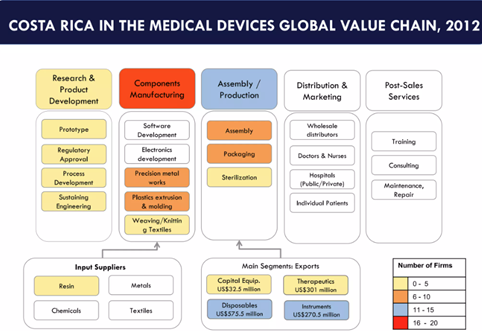
The globalisation of value chains has significant implications for policymakers, as it necessitates understanding not only domestic industrial dynamics but also international trade relationships and global market trends. Policymakers should aim to enhance the competitiveness of domestic industries by identifying opportunities for value addition, upgrading capabilities along the value chain, and fostering collaboration between firms and suppliers. Identifying national firms active across different stages of the value chain can provide a good starting point to understanding current capabilities and future market opportunities (see Figure 1 for such an analysis).
Figure 2. Example of value chain mapping in the medical devices industry in Costa Rica (Gereffi & Fernandez-Stark, 2016)
Industrial Value Chain Systems
Due to globalisation, industries have become increasingly fragmented and interdependent at the same time. Industrial value chain systems are thus global, with value-added processes spanning multiple countries. They are not only composed of production but also include pre- and post-production manufacturing services, which often also comprise high-value-added activities.
Understanding industrial systems and capabilities is a complex task. Just to exemplify this point: in the early years, enabling Apple's manufacturing operations in China required that the design of production processes be co-located with manufacturing in China. This has essentially led over time to the building up of local technological capabilities and the development of an entire semiconductor manufacturing ecosystem, often with speciality subcontractors and suppliers that today can only be found in China. Today, this makes it extremely difficult for Apple to disentangle its value chain (Financial Times, 2023a). Likewise, in recent years, Taiwan Semiconductor Manufacturing Company (TSMC) has faced several challenges constructing and opening new semiconductor manufacturing plants in Arizona, underlining how the loss of a production base can lead to diminishing technological capabilities in the long-term. Complex industrial systems and capabilities thus require careful and detailed analysis.
Given that emerging technologies, by definition, require establishing new or reconfiguring old supply and value chains, analysing and anticipating industrial value chain systems can help to identify high-value markets and leverage competitive advantage. It requires the identification of 1) global value chain activities (from R&D, design, etc., all the way to post-production services), and 2) companies across the different activities, which then enables understanding 3) current industrial capabilities within global value chains, and 4) potential high-value-added activities and future opportunities (Financial Times, 2023b).
Policy Context
Value chains are considered across multiple policy domains, each engaging with different aspects of how value is generated and retained:
- Science, Technology, and Innovation (STI) policy, where value chains are used to identify knowledge-intensive segments, research bottlenecks, and opportunities for technological upgrading. The policy purpose is to strengthen domestic capabilities in high-value functions such as R&D, design, and advanced production, and to improve linkages between research systems and productive activities.
- Industrial policy, where value chain analysis informs decisions on sector prioritisation, capability building, and upgrading strategies. Here, the focus is on moving firms and industries toward higher value-added stages, reducing dependence on low-margin activities, and supporting participation in strategically important segments of domestic and global value chains.
- Trade policy, at both national and international levels, where value chains highlight how production is fragmented across borders and how trade, investment, and rules shape value capture. Policy attention extends to trade agreements, investment regimes, and geopolitical considerations that influence access to key markets, technologies, and lead firms within global value chains.
- University and research policy, where value chains provide a lens for aligning education, skills development, and research priorities with future demand in high-value activities. The policy objective is to support human capital formation and knowledge diffusion that enable participation in advanced and innovation-intensive segments of value chains.
References
Ernst, D. (2004). Global production networks in East Asia's electronics industry and upgrading prospects in Malaysia. In S. Yusuf, M. A. Altaf, & K. Nabeshima (Eds.), Global production networking and technological change in East Asia (pp. 89-121). Oxford University Press.
Gereffi, G., & Fernandez-Stark, K. (2011). Global value chain analysis: A primer. Center on Globalization, Governance & Competitiveness, Duke University.
Gereffi, G., & Fernandez-Stark, K. (2016). Global value chain analysis: A primer. Center on Globalization, Governance & Competitiveness, Duke University.
Financial Times. (2023a). How Apple tied its fortunes to China.
https://www.ft.com/content/d5a80891-b27d-4110-90c9-561b7836f11b
Financial Times. (2023b). TSMC in the US: Can Taiwan's chip giant overcome a culture clash?. https://www.ft.com/content/7dd63d94-f645-45c6-8b82-b1808ee1cb31
Kaplinsky, R., & Morris, M. (2001). A handbook for value chain research. Institute of Development Studies, University of Sussex.
McCormick, D., & Schmitz, H. (2001). Manual for value chain research on homeworkers in the garment industry. Institute of Development Studies, University of Sussex.
McKinsey & Company. (2022). What is supply chain?. McKinsey & Company. https://www.mckinsey.com/featured-insights/mckinsey-explainers/what-is-supply-chain#/
Simatupang, T. M., Piboonrungroj, P., & Williams, S. J. (2017). The emergence of value chain thinking. International Journal of Value Chain Management, 8(1), 40-57.
SustainAbility, United Nations Environment Programme (UNEP), & United Nations Global Compact (UNGC). (2008). Unchaining value: Innovative approaches to sustainable supply. https://unglobalcompact.org/library/99
United Nations Industrial Development Organization (UNIDO). (2009). Agro-value chain analysis and development. https://www.unido.org/sites/default/files/2010-02/Agro_value_chain_analysis_and_development_0.pdf
Webber, C. M., & Labaste, P. (2009). Building competitiveness in Africa's agriculture: a guide to value chain concepts and applications. World Bank Publications.
Zamora, E. A. (2016). Value chain analysis: A brief review. Asian Journal of Innovation and Policy, 5(2), 116-128.