

Supply Chain: Definitions
Supply Chains
A supply chain is essentially defined as the sequence of processes involved in the production and distribution of a product or service, starting with the supply of raw materials and ending with the delivery of the finished commodity. Often, supply chain thinking emphasises the logistical, operational, and managerial processes needed to ensure efficient sourcing, manufacturing, warehousing, transport, distribution and delivery.
The management of such a chain, Supply Chain Management (SCM), is defined broadly as the planning and coordination of all these activities, across internal organisational boundaries and across multiple firms, to optimise total performance (cost, speed, reliability, responsiveness). In essence, it enables tracking the flow of inputs and outputs through firms. It is a useful strategic planning tool for assessing supply chain resilience and risk, but it does not necessarily enable the understanding of competitive advantage and market opportunities (the term value chain captures this point).
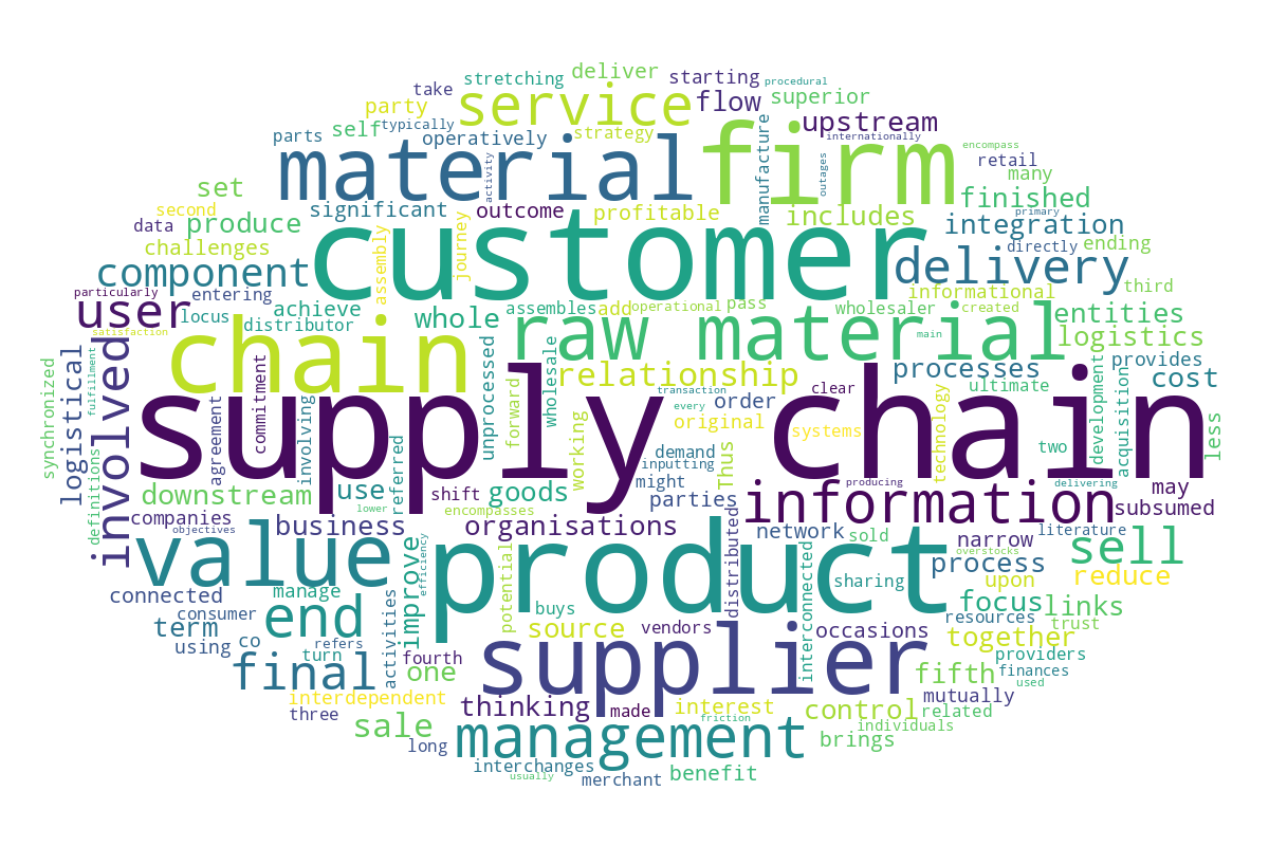
Figure 1. Word cloud of selected supply chain definitions
The Distinction Between Value Chains and Supply Chains
The distinction between supply chains and value chains becomes critical once the analytical focus shifts from operational efficiency to economic outcomes. Supply chain perspectives tend to prioritise the continuity, reliability, and efficiency of input-output flows across firms, making them particularly useful for analysing trade exposure, resilience, and security-related risks. In this framing, performance is often assessed in terms of cost reduction, logistics optimisation, and the mitigation of disruptions, with success measured by the smooth functioning of interconnected production and distribution activities.
By contrast, value chain perspectives direct attention to where and how economic value is created, captured, and retained across stages of development, production and use. This perspective is especially important for the study of emerging technologies, where the key policy and strategic concern is not only whether supply chains function efficiently, but which segments of the chain generate high value and how these can be developed or anchored domestically.
Conflating supply chain efficiency with value creation risks obscuring opportunities for upgrading and innovation, as efficient logistics alone do not guarantee meaningful value capture. Policymakers and analysts must therefore align their analytical lens and interventions with their objectives, distinguishing between efforts aimed at strengthening supply chain resilience and those intended to enhance value creation within technology-intensive sectors.
Selected Definitions of Supply Chains
The terms 'supply chain' and 'supply chain management' have multiple definitions across academia and practice. Below are selected definitions from different domains.
Table 1. Definitions of supply chain from various sources
|
Source |
Definition |
|
Christopher (2022) |
"The management of upstream and downstream relationships with suppliers and customers to deliver superior customer value at less cost to the supply chain as a whole." (p. 5)
"Thus the focus of supply chain management is upon the management of relationships in order to achieve a more profitable outcome for all parties in the chain. This brings with it some significant challenges since there may be occasions when the narrow self interest of one party has to be subsumed for the benefit of the chain as a whole." (p. 5).
"A network of connected and interdependent organisations mutually and co-operatively working together to control, manage and improve the flow of materials and information from suppliers to end users." (p. 6)
|
|
Cooper et al. (1997) |
"Supply chain management is the integration of business processes from end user through original suppliers that provides products, services and information that add value for customers." (p. 2)
|
|
Council of Supply Chain Management Professionals (CSCMP) (2013) |
"Supply chain: 1) starting with unprocessed raw materials and ending with the final customer using the finished goods, the supply chain links many companies together. 2) the material and informational interchanges in the logistical process stretching from acquisition of raw materials to delivery of finished products to the end user. All vendors, service providers and customers are links in the supply chain. (p. 186)
Supply Chain Management (SCM) encompasses the planning and management of all activities involved in sourcing and procurement, conversion, and logistics management. Importantly, it also includes coordination and collaboration with channel partners, such as suppliers, intermediaries, third-party service providers, and customers. In essence, supply chain management integrates supply and demand management within and across firms. It is an integrating function with primary responsibility for linking major business functions and processes within and across organisations into a cohesive and high-performing business model." (p. 187)
|
|
Islam (2023) |
"Supply chains are the synchronized systems of all related entities, processes, resources, information, and technology involved, from the delivery of the source materials of products to the products' ultimate delivery to the customers." (p. 2)
|
|
La Londe & Masters (1994) |
"One firm might produce a raw material and sell it to a second firm which uses the material to produce a component. A third firm buys the component and assembles it into a product which is sold to a fourth firm such as a wholesale distributor. The wholesaler in turn sells the product to a fifth firm, such as a retail merchant, and the fifth firm sells the product to a consumer. The set of firms which pass these materials forward can be referred to as a supply chain." (pp. 4-5)
"Supply chain strategy includes [...] two or more firms in a supply chain entering into a long-term agreement; [...] the development of trust and commitment to the relationship; [...] the integration of logistics activities involving the sharing of demand and sales data; [...] the potential for a shift in the locus of control of the logistics process." (p. 15)
|
|
McKinsey & Company (2022) |
"The supply chain is the interconnected journey that raw materials, components, and goods take before their assembly and sale to customers." (p. 1)
"A supply chain includes all the raw materials and parts that are made into a product and distributed up the chain for manufacture and sale." (p. 2)
|
|
Mentzer et al. (2001) |
"A set of three or more entities (organizations or individuals) directly involved in the upstream and downstream flows of products, services, finances, and/or information from a source to a customer." (p. 4)
|
|
SustainAbility, UNEP & UN Global Compact (2008) |
"Supply chains and value chains have clear definitions in business literature and operational thinking. Where a supply chain typically refers to the chain of suppliers inputting to a final product, value chain also encompasses thinking about the value created by the chain, particularly for end-use customers." (p. 2)
|
|
Webber & Labaste (2009) |
"[...] the term 'supply chain' is used internationally to encompass every logistical and procedural activity involved in producing and delivering a final product or service, 'from the supplier's supplier to the customer's customer' [...]). Since the primary focus of supply chains is efficiency, the main objectives are usually to reduce 'friction' (for example, delays, blockages, or imbalances), reduce outages or overstocks, lower transaction costs, and improve fulfillment and customer satisfaction." (p. 9)
|
Policy Context
Supply chains have become a central concern for policymakers because they underpin economic activity, public service provision, and access to essential goods, while being increasingly exposed to systemic risks that extend beyond the control of individual firms. Their performance is shaped by cross-border flows, shared infrastructure, technological capabilities, and interdependencies across sectors, making supply chains a policy issue that requires coordinated, system-level intervention rather than firm-level optimisation alone.
In this context, supply chains intersect with multiple policy domains, each addressing distinct coordination challenges and vulnerabilities:
- Science, Technology, and Innovation (STI) policy, where supply chains are addressed through efforts to strengthen technological resilience, digital security, and innovation capacity in strategically important sectors. STI policy contributes by embedding security and robustness considerations early in the design of digitally enabled supply networks, supporting long-term capability development, and reducing vulnerability arising from dependence on single sources or fragile technological components.
- Industrial policy, where supply chains are targeted to support productive capacity, address bottlenecks, and strengthen domestic or regional capabilities in strategically important sectors. Here, policy attention focuses on supplier ecosystems, manufacturing readiness, and the alignment of upstream and downstream capabilities to improve reliability and adaptability.
- Trade policy, encompassing both national and international dimensions, where tariffs, trade agreements, customs procedures, and trade rules shape cross-border flows, diversification strategies, and exposure to external shocks. Trade policy plays a central role in managing dependencies, market access, and geopolitical risk within global supply chains.
- Infrastructure and transport policy, which influences the reliability and efficiency of the physical and digital systems that enable supply chain connectivity, including ports, roads, rail, energy networks, and communications infrastructure.
References
Christopher, M. (2005). Logistics and supply chain management (3rd ed.). Pearson Education.
Cooper, M. C., Lambert, D. M., & Pagh, J. D. (1997). Supply chain management: More than a new name for logistics. The International Journal of Logistics Management, 8(1), 1-14.
Council of Supply Chain Management Professionals (CSCMP). (2013). Supply chain management terms and glossary. https://cscmp.org/CSCMP/cscmp/educate/scm_definitions_and_glossary_of_terms.aspx
Islam, M. D. (2023). A survey on the use of blockchains to achieve supply chain security. Information Systems, 117, 102232.
La Londe, B. J., & Masters, J. M. (1994). Emerging logistics strategies: Blueprints for the next century. International Journal of Physical Distribution & Logistics Management, 24(7), 35-47.
Mentzer, J. T., DeWitt, W., Keebler, J. S., Min, S., Nix, N. W., Smith, C. D., & Zacharia, Z. G. (2001). Defining supply chain management. Journal of Business Logistics, 22(2), 1-25.
McKinsey & Company. (2022). What is supply chain?. McKinsey & Company. https://www.mckinsey.com/featured-insights/mckinsey-explainers/what-is-supply-chain#/
SustainAbility, United Nations Environment Programme (UNEP), & United Nations Global Compact (UNGC). (2008). Unchaining value: Innovative approaches to sustainable supply. https://unglobalcompact.org/library/99
Webber, C. M., & Labaste, P. (2009). Building competitiveness in Africa's agriculture: A guide to value chain concepts and applications. World Bank Publications.