

Technology Transfer: Definitions
Technology Transfer
Technology transfer is understood as a deliberate and often structured process through which technological knowledge, capabilities, or artefacts are conveyed from one organisational, institutional, or sectoral context to another to enable effective use, adaptation, and further development. It encompasses not only the movement of codified technologies, such as products, processes, or intellectual property, but also the transmission of tacit know-how, skills, and organisational practices and routines required for successful application.
Technology transfer is typically relational and iterative rather than a one-off transaction, frequently involving sustained interaction between providers and recipients to bridge the gap between potential and actual utilisation. It may take place within or across systems, sectors, or countries and is closely associated with innovation processes, as transferred knowledge is absorbed, adapted to local conditions, and translated into new or improved products, services, or production capabilities.
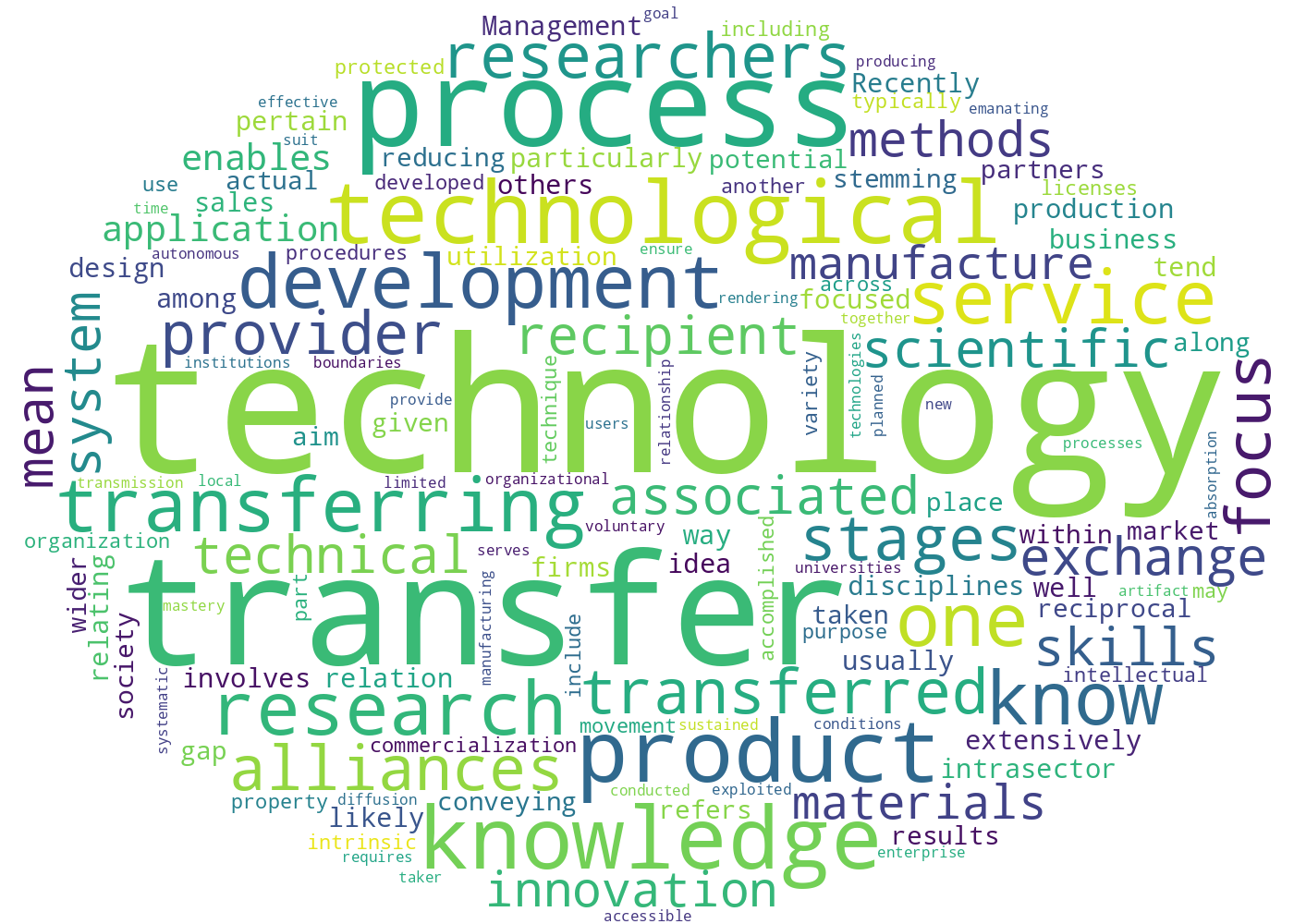
Figure 1. Word cloud of selected technology transfer definitions
Selected Definitions of Technology Transfer
The table below highlights selected definitions of technology transfer.
Table 1. Definitions of technology transfer from various sources
|
Source |
Definition |
|
Blakeney (1989) |
"Technology transfer refers to the process through which technological knowledge, capabilities, or commercially relevant technologies are disseminated from one organisation, sector, or context to another. This process may occur through formal technology transfer transactions, which may or may not be governed by legally binding contracts." (p. 136)
|
|
Bozeman, 2000 |
"[…] those from the business disciplines tend to focus on stages of technology transfer, particularly relating design and production stages, as well as sales, to transfer […]. Management researchers are more likely than others to focus on intra-sector transfer […] and on the relation of technology transfer to […]. Recently, researchers […] have focused extensively on alliances among firms and how alliances pertain to the development and transfer of technology."
|
|
Corsten (1982) |
"[…] is the idea of technology being transferred from a technology provider to a technology recipient. […] technology transfer is not a one-way process but one which usually involves a reciprocal exchange between the partners to the transfer. […] technology transfer is taken to mean the process of transferring a technology, i.e. a technical process or product, within a given system or between systems, with the aim of reducing the gap between potential and actual utilization of a technology." (pp. 57-58)
|
|
European Commission (2023) |
"Technology transfer (TT) refers to the process of conveying results stemming from scientific and technological research to the market place and to wider society, along with associated skills and procedures, and is as such an intrinsic part of the technological innovation process."
|
|
Gardner (n.d) |
"Technology transfer is a process in which technology or knowledge developed at one organization is transferred to another, typically for the purpose of commercialization. Technology transfer can be accomplished through a variety of methods including licenses to use protected intellectual property, and may also include exchange of know-how and materials."
|
|
Roessner (1993) |
"Technology transfer is the movement of know how, technique, and technology across organizational boundaries." (p. 31)
|
|
Schuh et al., (2022) |
"Technology transfer is the planned, time-limited and voluntary process of transferring a technology from a technology provider (explicitly science) to a technology taker (explicitly industry). Technology means a technical artifact together with the associated knowledge. The transfer does not take place as an end in itself but serves the overriding goal of producing technological innovations." (p. 26)
|
|
UNCTAD (2001) |
"[…] 'technology' as 'systematic knowledge for the manufacture of a product, for the application of a process or for the rendering of a service', which does not extend to transactions involving the mere sale or mere lease of goods." (pp. 5-6)
|
|
Wahab et al. (2012) |
"[…] as the transmission of know-how to suit local conditions, with effective absorption and diffusion both within and across countries. […] technology transfer as transmission of know-how (knowledge) which enable the recipient enterprise to manufacture a particular product or provide a specific service. As compared to the sale of machinery and equipment, the transfer of technology requires a sustained relationship between two enterprises over a period of time to enable the receiving enterprise to produce the product with the desired level of quality standards and cost efficiency. […] who argues that technology transfer does not only transfer the technical know-how (knowledge) required to produce the product to the recipient but also the capacity to master, develop and later produce autonomously the technology underlying the products." (p. 63)
|
|
WIPO (2024) |
"The process of transferring skills, knowledge, technologies or methods of manufacturing emanating from research conducted at universities or research institutions to other users (institutions, industry, the government, charities or the community) to ensure that scientific and technological developments are accessible to a wider range of users who can then further develop and exploit the technology into new products, processes, applications, materials or services." (p. 2)
|
Primary Mechanisms of Technology Transfer
Technology transfer occurs through a wide range of formal and informal channels that differ in their degree of codification, institutionalisation, and orientation toward commercial or societal outcomes. In particular, academic knowledge and innovative technologies are transferred and used for scientific, technical, socio-economic, and commercial purposes through multiple, often complementary, modes:
- Codified knowledge dissemination: Transfer takes place through codified knwowledge dissemination such as publications, technical journals, scientific magazines, patent documents, and open-access repositories, which enable broad diffusion of research results and technical knowledge. This type of dissemination may hide tacit knowledge that may be required for successful transfer.
- Interpersonal interaction and professional exchange: Conferences, presentations, professional organisations, training courses, and informal personal contacts facilitate the transfer of tacit knowledge that cannot be fully captured in written form.
- Collaborative and contract-based research: Sponsored research, contract research, and joint R&D collaborations between universities, public research institutions, and firms enable co-development and mutual learning, embedding transfer within ongoing research activity.
- Human mobility and skills transfer: Technology transfer occurs through the movement of people, including postgraduate projects, students entering the workforce, staff exchanges between academia and industry, and consultancy work by university researchers.
- Intellectual property-based mechanisms: Assignment and licensing of intellectual property provide formal channels for transferring protected technologies, often accompanied by technical support and knowledge exchange.
- Entrepreneurial and organisational channels: Spin-offs and start-ups translate research results into new ventures, combining technological knowledge with market exploration and organisational capability building.
Policy Context
Multiple policy domains engage with technology transfer for distinct but interrelated purposes are as follows:
- Science, Technology, and Innovation (STI) policy: STI policy addresses technology transfer as part of the mandate to ensure that publicly funded research delivers societal and economic impact. Policy attention focuses on enabling translational pathways, supporting knowledge exchange between research and industry, and aligning incentives for collaboration, impact, and capability development.
- Industrial policy: From an industrial policy perspective, technology transfer supports firm-level learning, productivity growth, and industrial upgrading by facilitating access to external knowledge and technologies. Policy priorities include strengthening absorptive capacity, supporting research–industry partnerships, and enabling the adaptation and scaling of transferred technologies within domestic production systems.
- Trade policy: Technology transfer is closely linked to cross-border investment, joint ventures, and participation in global value chains. Trade policy engages with technology transfer to shape the conditions under which knowledge and capabilities move internationally, balancing objectives related to competitiveness, upgrading, strategic autonomy, and geopolitical risk.
- Intellectual property (IP) policy: IP policy structures technology transfer by defining how knowledge can be protected, disclosed, and shared. Effective IP regimes balance incentives for innovation with mechanisms that support licensing, collaboration, and diffusion, influencing whether transfer leads to sustained capability building or remains transactional.
- University and research policy: It governs how public research organisations manage, prioritise, and operationalise technology transfer. This includes the design and role of technology transfer offices, researcher incentives, engagement with external partners, and the selection of appropriate transfer channels such as licensing, spin-offs, collaborative research, and open dissemination. The policy objective is to maximise the socio-economic impact of research while preserving academic missions and research integrity.
References
Blakeney, M. (1989). Legal aspects of technology transfer to developing countries. ESC.
Bozeman, B. (2000). Technology transfer and public policy: A review of research and theory. Research Policy, 29(4-5), 627-655.
Corsten, H. (1987). Technology transfer from universities to small and medium-sized enterprises—an empirical survey from the standpoint of such enterprises. Technovation, 6(1), 57-68.
European Commission. (2023). Competence Centre on Technology Transfer. https://knowledge4policy.ec.europa.eu/technology-transfer/what-technology-transfer_en
Gardner. (n.d.) What is Technology Transfer?. https://gardnerisp.com/what-is-technology-transfer/
Roessner, J. D. (1993). National issues in technology transfer. In Review of Progress in Quantitative Nondestructive Evaluation: Volumes 12A and 12B (pp. 31-39). Boston, MA: Springer US.
Schuh, G., Latz, T., & Lorenz, J. (2022). Governmental support options for the technology transfer of deep tech innovations. Information Technology & Management Science, 25.
United Nations Conference on Trade and Development (UNCTAD). (2001). Transfer of technology. https://unctad.org/system/files/official-document/psiteiitd28.en.pdf
Wahab, S. A., Rose, R. C., & Osman, S. I. W. (2012). Defining the concepts of technology and technology transfer: A literature analysis. International Business Research, 5(1), 61-71.
WIPO. (2024). Incentives in technology transfer: A guide to encourage, recognize and reward researchers and professionals. https://www.wipo.int/edocs/pubdocs/en/wipo-pub-2002-en-incentives-in-technology-transfer.pdf