

Emerging Technology: Definitions
Emerging Technology
Emerging technologies can most usefully be defined relative to their stage of development as technologies that do not yet have an established knowledge, technology, and/or application base. In other words, there is no universally used core technology platform, standard configuration, dominant product design, set of materials and components, and thus, clear supply and demand. Emerging technologies require the development of 1) novel research and engineering innovations, including knowledge and infrastructure; 2) new supply chains and industrial capabilities; and 3) the exploration of market applications and formation of a user base.
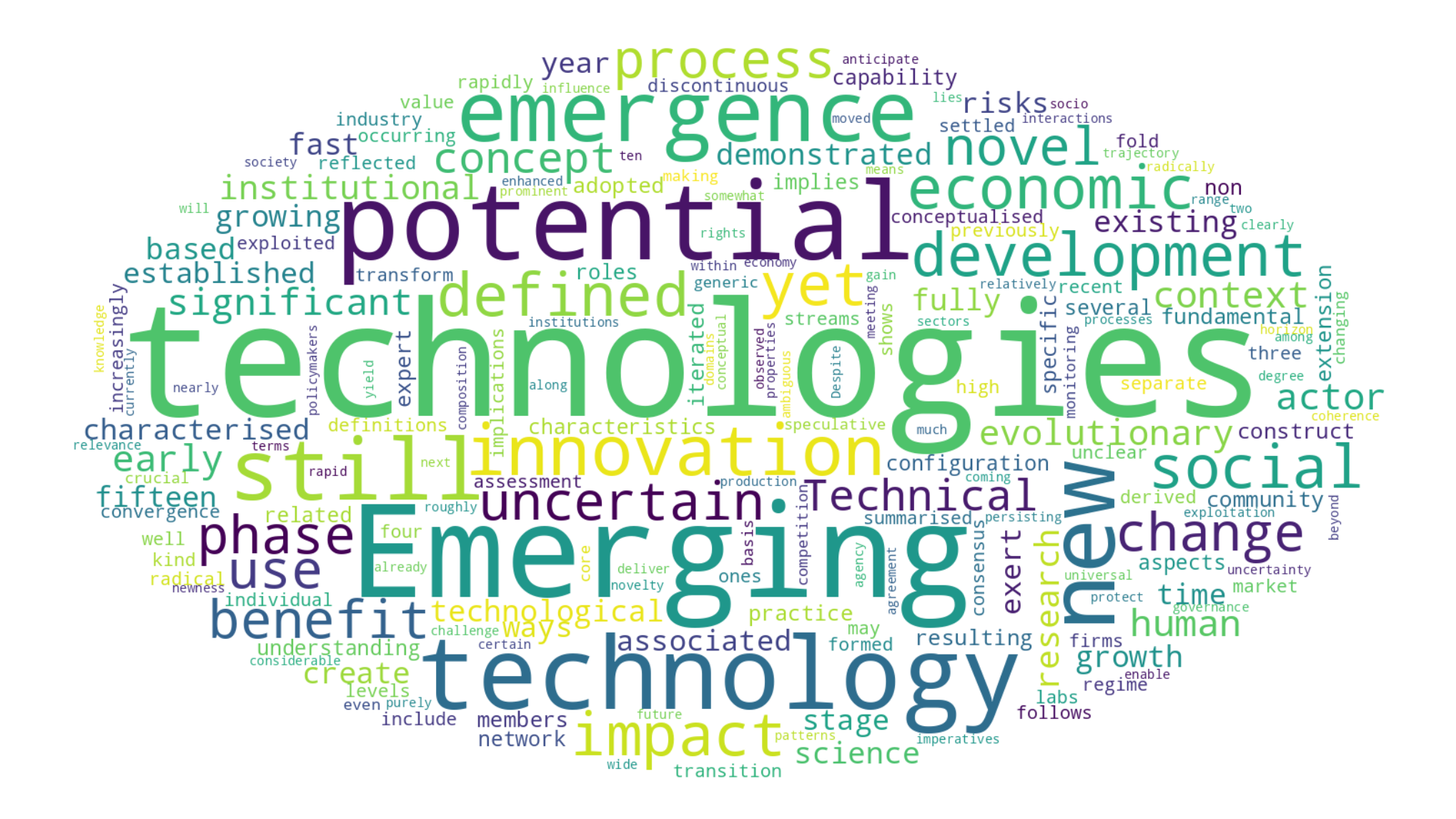
Figure 1. Word cloud of selected emerging technology definitions
Selected Definitions of Emerging Technology
The term 'emerging technology' has been defined in multiple ways depending on disciplinary perspectives and intended use. Below are selected definitions from different sources.
Table 1. Definitions of emerging technology from various sources
|
Source |
Definition |
|
Alexander et al. (2012) |
“Technical emergence is the phase during which a concept or construct is adopted and iterated by […] members of an expert community of practice, resulting in a fundamental change in (or significant extension of) human understanding or capability.” (p. 1289)
|
|
Boon & Moors (2008) |
“Emerging technologies are technologies in an early phase of development. This implies that several aspects, such as the characteristics of the technology and its context of use or the configuration of the actor network and their related roles are still uncertain and non-specific” (p. 1915)
|
|
Corrocher et al. (2003) |
“The emergence of a new technology is conceptualised [...] as an evolutionary process of technical, institutional and social change, occurring at three levels: individual firms/research labs, social and institutional context, and technological regime.” (p. 4)
|
|
Cozzens et al. (2010) |
“Emerging technology — a technology that shows high potential but hasn’t demonstrated its value or settled down into any kind of consensus.” (p. 364).
“The concepts reflected in the definitions of emerging technologies, however, can be summarised four-fold as follows: (1) fast recent growth; (2) in the process of transition and/or change; (3) market or economic potential that is not exploited fully yet; (4) increasingly science-based.” (pp. 365–366)
|
|
Day & Schoemaker (2000) |
“[…] emerging technologies as science-based innovation that have the potential to create a new industry or transform an existing ones. They include discontinuous innovations derived from radical innovations […] as well as more evolutionary technologies formed by the convergence of previously separate research streams” (p. 30)
|
|
European Commission (2025) |
“Emerging technologies are rapidly growing with still unclear potential, use, and implications. Their development is still uncertain, and the assessment may be speculative, making monitoring even more crucial.” (p. 5)
|
|
Hung & Chu (2006) |
“Emerging technologies are the core technologies, which have not yet demonstrated potential for changing the basis of competition” (p. 104)
|
|
Martin (1995) |
“A generic emerging technology is defined [...] as a technology the exploitation of which will yield benefits for a wide range of sectors of the economy and/or society.” (p. 165).
|
|
OECD (n.d.) |
Emerging technologies, [..], are characterised by rapid development and uncertainty in trajectory and impact. A challenge for policymakers is to enable innovation where technologies deliver social and economic benefit, while meeting the governance imperatives that anticipate risks, protect established rights and human agency.
|
|
Porter et al. (2002) |
“Emerging technologies are defined [...] as those that could exert much enhanced economic influence in the coming (roughly) 15-year horizon.” (p. 189)
|
|
Rotolo et al. (2015) |
“A radically novel and relatively fast growing technology characterised by a certain degree of coherence persisting over time and with the potential to exert a considerable impact on the socio-economic domain(s) which is observed in terms of the composition of actors, institutions and patterns of interactions among those, along with the associated knowledge production processes. Its most prominent impact, however, lies in the future and so in the emergence phase is still somewhat uncertain and ambiguous.” (p.1828)
|
|
Small et al. (2014) |
“[…] there is nearly universal agreement on two properties associated with emergence — novelty (or newness) and growth.” (p. 2)
|
|
Stahl (2011) |
“[…] emerging technologies are defined as those technologies that have the potential to gain social relevance within the next 10 to 15 years. This means that they are currently at an early stage of their development process. At the same time, they have already moved beyond the purely conceptual stage. […] Despite this, these emerging technologies are not yet clearly defined. Their exact forms, capabilities, constraints, and uses are still in flux” (pp. 3–4)
|
|
United States Government Accountability Office (2016) |
“[…] to be novel technologies, or new applications of preexisting technologies, with far-reaching, disruptive potential, and risks and benefits that are not yet fully known.” (p.2)
|
|
World Economic Forum (2025) |
“[…] ‘emerging technologies’ encompasses both entirely novel innovations and established technologies being applied in transformative new ways. This inclusive approach recognizes that technological emergence occurs through multiple pathways – whether through groundbreaking new discoveries or through applying existing technologies to solve different problems in ways that could create significant new impact.”
|
Policy Context
Emerging technologies pose distinct challenges for policymaking due to high uncertainty, incomplete knowledge, unclear applications, and open future trajectories. Unlike mature technologies, emerging technologies require policy engagement before their economic, social, and institutional implications are fully understood, often in the absence of established markets, standards, or dominant designs. As a result, different policy domains engage with emerging technologies at different points in time and for different purposes, making coordination both necessary and difficult.
In this context, emerging technologies are considered across multiple policy domains, each focusing on specific uncertainties and bottlenecks that arise before technological maturity:
- Science, Technology, and Innovation (STI) policy, where emerging technologies are addressed at stages when core scientific principles, technical feasibility, and research pathways remain uncertain. The policy purpose is to support exploratory research, experimentation, and the development of foundational knowledge and infrastructure in the presence of high risk and limited immediate returns.
- Industrial policy, where emerging technologies are engaged once technical feasibility begins to emerge but pathways to scaling and integration remain unclear. Here, the policy focus is on reducing coordination failures, supporting early industrial capabilities, and managing the transition from experimental development to pre commercial or early commercial deployment.
- Trade policy, encompassing both national and international dimensions, where emerging technologies raise concerns precisely because future market structures, competitive advantages, and dependencies are not yet stabilised. In this context, policy attention extends to tariffs, non-tariff measures, foreign direct investment, and geopolitical considerations related to strategic positioning, control of critical inputs, and exposure to technological dependence before global markets fully form.
- University and research policy, where emerging technologies create uncertainty about future skills needs, research priorities, and pathways for knowledge circulation. The policy purpose is to maintain flexibility in research agendas, develop human capital in anticipation of future demand, and enable translation across disciplinary and institutional boundaries before applications are clearly defined.
Understanding emerging technologies in this way helps explain why policy priorities diverge across domains and why misalignment can persist even when there is broad agreement on the strategic importance of a technology.
References
Alexander, J., Chase, J., Newman, N., Porter, A., & Roessner, J. D. (2012). Emergence as a conceptual framework for understanding scientific and technological progress. In 2012 Proceedings of PICMET'12: Technology Management for Emerging Technologies (pp. 1286-1292). IEEE.
Boon, W., & Moors, E. (2008). Exploring emerging technologies using metaphors: A study of orphan drugs and pharmacogenomics. Social Science & Medicine, 66(9), 1915-1927.
Corrocher, N., Malerba, F., & Montobbio, F. (2003). The emergence of new technologies in the ICT field: Main actors, geographical distribution and knowledge sources. Working Papers of Faculty of Economics. Universit degli Studi dell’Insubria.
Cozzens, S., Gatchair, S., Kang, J., Kim, K. S., Lee, H. J., Ordóñez, G., & Porter, A. (2010). Emerging technologies: Quantitative identification and measurement. Technology Analysis & Strategic Management, 22(3), 361-376.
Day, G. S., & Schoemaker, P. J. (2000). Avoiding the pitfalls of emerging technologies. California Management Review, 42(2), 8-33.
European Commission. (2025). Technology monitoring and assessment: Quarterly R&I literature review 2025/Q2. https://op.europa.eu/fr/publication-detail/-/publication/c0096af8-7735-11f0-9af8-01aa75ed71a1/language-en
Hung, S. C., & Chu, Y. Y. (2006). Stimulating new industries from emerging technologies: Challenges for the public sector. Technovation, 26(1), 104-110.
Martin, P. A. (1999). Genes as drugs: The social shaping of gene therapy and the reconstruction of genetic disease. Sociology of Health & Illness, 21(5), 517-538.
Organisation for Economic Co-operation and Development (OECD). (n.d.). Emerging technologies. https://www.oecd.org/en/topics/sub-issues/emerging-technologies.html
Porter, A. L., Roessner, J. D., Jin, X. Y., & Newman, N. C. (2002). Measuring national 'emerging technology' capabilities. Science and Public Policy, 29(3), 189-200.
Rotolo, D., Hicks, D., & Martin, B. R. (2015). What is an emerging technology?. Research Policy, 44(10), 1827-1843.
Small, H. (2006). Tracking and predicting growth areas in science. Scientometrics, 68(3), 595-610.
Stahl, B. C. (2011). What does the future hold? A critical view of emerging information and communication technologies and their social consequences. In Researching the Future in Information Systems: IFIP WG 8.2 working conference, Turku, Finland, June 6-8, 2011. Proceedings (pp. 59-76). Berlin, Heidelberg: Springer Berlin Heidelberg.
United States Government Accountability Office. (2016). Selected emerging technologies highlight the need for legislative analysis and enhanced coordination (GAO-16-659SP). U.S. Government Accountability Office. https://www.gao.gov/assets/d24106122.pdf
World Economic Forum. (2025). Top 10 Emerging Technologies of 2025. https://www.weforum.org/publications/top-10-emerging-technologies-of-2025/in-full/methodology-7f0fa39e6b/