

Deep Technology: Definitions
Deep Technology
Deep technology (deep tech) refers to technologies grounded in breakthrough science and advanced engineering, characterised by long development cycles, high levels of technical uncertainty, and capital-intensive research, including the need for specialised infrastructure and sustained research efforts before large-scale deployment.
Deep technologies aim to create fundamentally new capabilities or address complex societal and global challenges, rather than deliver incremental improvements to existing technologies. They are typically knowledge-intensive and difficult to replicate, relying on deep intellectual property, tacit expertise, and complex system integration.
Figure 1. Word cloud of selected deep technology definitions
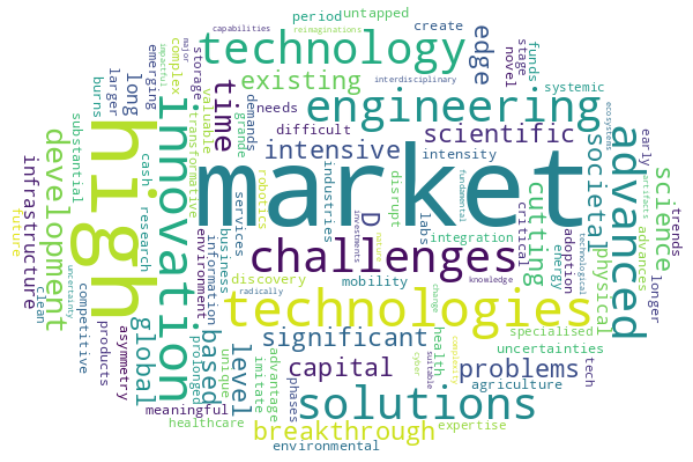
Selected Definitions of Deep Technology
The term 'deep technology' has been used in multiple ways to characterise ventures or projects, with long development timelines, capital intensity, and high risk profiles used as proxies for underlying technological depth. The table below presents selected definitions, illustrating this common emphasis on the conditions and pathways through which deep technologies are developed and translated into applications.
Table 1. Definitions of deep technology from various sources
|
Source |
Definition |
|
De Apodaca, Murrah & Frolund (2023) |
"[…] defining deep tech as 'science-based technology solutions' associated with critical dimensions of uncertainty, a perspective that allows for the changing dynamics characteristic of a fast-changing technological landscape." (p. 2)
"Deep tech is that part of the solution space based on breakthrough science and engineering." (p. 2)
"Deep tech presents two types of barriers to entry: i) the existence of a high level of information asymmetry, and ii) the presence of a high level of capital intensity." (p. 4)
|
|
De la Tour et al. (2019) |
"Deep technologies are novel and offer significant advances over technologies currently in use. They require substantial R&D to develop practical business or consumer applications and bring them from the lab to the market. Many of these technologies address big societal and environmental challenges and will likely shape the way we solve some of the most pressing global problems. These technologies have the power to create their own markets or disrupt existing industries. The underlying IP is either hard to reproduce or well protected, so they often have a valuable competitive advantage or barrier to entry. […]. These technologies can have a big impact, take a long time to reach market-ready maturity, and require a significant amount of capital." (p. 7)
|
|
Capatina et al. (2024) |
"Deep tech firms are companies that develop and offer cutting-edge, technology-intensive products or services, often based on advanced research and development efforts. Deep tech firms spend a lot of time in innovation labs before being capable of bringing tech to market and achieving real market adoption […]. Deep tech firms are confronted with regular analyses of potential future market demands, emerging trends, and evolving consumer needs, to align their strong tech capabilities with the future market landscape." (p. 1)
"Deep tech startups operate at the forefront of technological innovation, developing cutting-edge solutions that often address complex challenges and untapped market needs." (p. 2)
|
|
Kim & Srivastava (2024) |
"Deep tech projects, based on breakthrough scientific or engineering innovations and new ways of problem-solving, are riddled with uncertainties as both opportunity and challenge." (p. 1)
|
|
Kilic & Duran (2021)
|
"Deep tech has the potential to solve the most pressing global challenges, including ones involving the environment, society, and health." (p. 8)
"Deep tech is about scientific discovery and meaningful engineering innovation…not a business model on digital technologies...not a process, product, service, or function innovation that uses digital technologies […]" (p. 90)
"[…] it aims to solve the most critical global problems in areas such as health, mobility, agriculture, environment, and business and to transform the world by solving them… deep tech companies push the scientific and engineering limits, conducting scientific research in labs…to come up with advanced technologies that are unique and difficult to imitate" (p. 90)
"[…] it needs relatively larger funds than most other start-ups and burns cash over a longer period of time […]" (p. 90)
|
|
Podbreznik et al. (2024)
|
"…integrate new technological innovations to create transformative solutions across sectors such as healthcare, advanced robotics, clean-tech, and energy storage." (p. 1)
"Deep tech typically involves prolonged development phases, requires specialised expertise, and demands significant infrastructure. Capital intensity increases significantly during the later stages, particularly before market entry when establishing production facilities." (p. 1)
|
|
Romasanta et al. (2022) |
"Early-stage technologies based on scientific or engineering advances, requiring long development times, systemic integration, and sophisticated knowledge to create downstream offerings with the potential to address grand societal challenges." (pp. 13-14)
|
|
Romme (2022) |
"Deeptech…ventures: develop products and systems with a very high technological complexity, arising from the combination of extremely complex hardware and software.; have a long time-to-market of usually at least 3 to 5 years - but often much longer - and thus require major investments, in terms of both financial and human resources.; often require extensive innovation ecosystems (or clusters of collaborating firms) around the deeptech value proposition of the focal venture, in which various suppliers also have to invest in developing new components and services." (p. 3)
|
|
Royal Academy of Engineering (2023) |
"There is no universal definition of deep tech, and other terms like hard tech and tough tech are also in the mix. By its very nature, the term encompasses a broad and evolving spectrum of innovative technologies, and what constitutes deep tech may vary based on the perspectives and metrics of different stakeholders. What does appear to be common in the definition of deep tech companies is that the technologies are grounded in innovative engineering and cutting-edge scientific advances and the companies are recognised as being capital, time and R&D intensive." (p. 1)
|
|
Schuh et al. (2022) |
"Deep Tech represents innovative technologies of (cyber-) physical nature that are characterized by long development times, high capital requirements, as well as high market and technology uncertainty, and addresses fundamental societal as well as environmental challenges. Deep Tech exhibits significant technological advancement compared to established technologies and have the potential to radically change existing markets or create completely new ones." (p. 25)
"Deep technology (DT) describes knowledge-based technologies that have the potential to radically change existing markets or to create entirely new markets […] The development of deep technology from research to market maturity requires an above-average consumption of resources, especially financially, as well as a high investment of time […] DT addresses the substantial societal and environmental problems […]." (p. 25)
"[…] regulatory uncertainties regarding the development and application of DT often exist […] Another characteristic of DT is its interdisciplinary nature…physical artifacts are necessary included […] the production of physical products requires the existence of a suitable infrastructure, which is associated with a considerable expenditure of resources." (p. 25)
|
|
Siegel & Krishnan (2020) |
"A 'Deep' Technology was impossible yesterday, is barely feasible today, and will quickly become so pervasive and impactful that it is difficult to remember life without. Deep Tech solutions are reimaginations of fundamental capabilities that are faithful to real and significant problems or opportunities, rather than to one discipline." (p. 8)
|
Policy Context
Deep technologies are addressed and supported across multiple policy domains, each addressing different development bottlenecks and coordination challenges:
- Science, Technology, and Innovation (STI) policy, where deep technologies are addressed through sustained support for frontier research, specialised infrastructure, and interdisciplinary capability building. The policy purpose is to enable long-term scientific and engineering progress under conditions of high technical uncertainty, where outcomes cannot be specified ex-ante and learning occurs cumulatively over time.
- Industrial policy, where deep technologies are considered in relation to scaling pathways, manufacturing feasibility, and system integration. Here, the policy focus is on bridging translation gaps between research and production, supporting pilot facilities and demonstration systems, and aligning industrial capabilities with technologies that may only mature over long time horizons.
- Trade policy, encompassing both national and international dimensions, where deep technologies raise issues related to capital intensity, global collaboration, and access to specialised inputs, equipment, and talent. In this context, policy attention includes managing cross-border research collaboration, investment flows, and supply dependencies in environments where development costs are high and global knowledge networks are essential.
- University and research policy, where deep technologies create sustained demands for advanced skills, long-term research programmes, and stable institutional support. The policy purpose is to maintain research continuity, develop specialised human capital, and support translational mechanisms that can operate across extended periods without premature pressure for commercialisation.
References
De Apodaca, O. R., Murray, F., & Frolund, L. (2023). What is "deep tech" and what are deep tech ventures. Tech. rep. MIT Regional Entrepreneurship Acceleration Program.
De la Tour, A., Portincaso, M., Blank, K., Goeldel, N., Aré, L., Tallec, C., Gourévitch, A., & Pedroza, S. (2019). The dawn of the deep tech ecosystem. Boston Consulting Group & Hello Tomorrow. https://media-publications.bcg.com/france/Deep-Tech-Report_BCG_HelloTomorrow.pdf
Capatina, A., Bleoju, G., & Kalisz, D. (2024). Falling in love with strategic foresight, not only with technology: European deep-tech startups' roadmap to success. Journal of Innovation & Knowledge, 9(3), 100515.
Kim, F. D., & Srivastava, R. (2024). An innovation matrix: Deep tech projects, uncertainties, and entrepreneurial strategies. California Management Review, 66(4). https://cmr.berkeley.edu/assets/documents/pdf/2024-10-an-innovation-matrix-deep-tech-projects-uncertainties-and-entrepreneurial-strategies.pdf
Kilic, A. S., & Duran, C. (2021). An analysis of similarities and dissimilarities among categories of deep tech entrepreneurship: Evidence from Turkey. Girisimcilik ve Inovasyon Yonetim Dergisi.
Podbreznik, M., Degen, F., & Kampker, A. (2024). Challenges and potentials in evaluating early-stage deep technology. In 2024 Portland International Conference on Management of Engineering and Technology (PICMET) (pp. 1-8). IEEE.
Romasanta, A., Ahmadova, G., Wareham, J. D., & Pujol Priego, L. (2021). Deep tech: Unveiling the foundations. ESADE Working Papers Series 276. http://dx.doi.org/10.2139/ssrn.4009164
Romme, A. G. L. (2022). Against all odds: How Eindhoven emerged as a deeptech ecosystem. Systems, 10(4), 119.
Royal Academy of Engineering. (2023). State of UK deep tech 2023. Royal Academy of Engineering. https://raeng.org.uk/media/2y2kkamv/state-of-uk-deep-tech-2023.pdf
Schuh, G., Latz, T., & Lorenz, J. (2022). Governmental support options for the technology transfer of deep tech innovations. Information Technology & Management Science, 25.
Siegel, J., & Krishnan, S. (2020). Cultivating invisible impact with deep technology and creative destruction. Journal of Innovation Management, 8(3), 6-19.