

Critical Technology: Definitions
Critical Technology
Critical technologies are characterised by their strategic importance to national interest, particularly in relation to national security, economic prosperity, and societal resilience. They enable or underpin essential systems and capabilities, such that their availability, control, or disruption can have significant national or international consequences. Criticality is closely linked to concerns over technological dependence, supply chain concentration, and geopolitical risk, as well as the ability to retain, develop, or secure access to key technological capabilities. These technologies are often dual-use or multi-use, spanning civilian, industrial, and defence applications, and frequently function as rate-determining or enabling components within broader systems. They may include both mature and emerging technologies, including those at early or pre-competitive stages, where safeguarding strategic options and long-term competitiveness is particularly important.
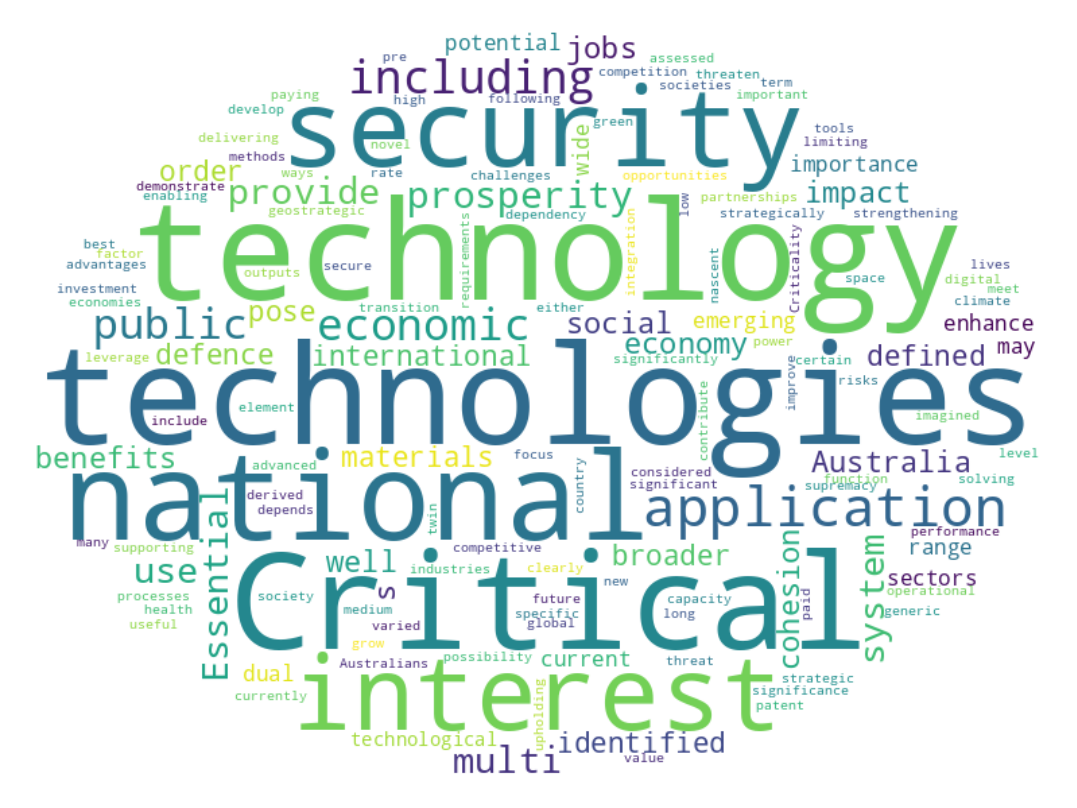
Figure 1. Word cloud of selected critical technology definitions
Selected Definitions of Critical Technology
The term 'critical technology' has been used in different ways, with most definitions emerging from government and policy contexts where technologies are assessed in relation to national capability, security, and strategic dependence. These definitional approaches are neither uniform nor mutually exclusive, reflecting different policy objectives, institutional mandates, and national priorities. The table below shows illustrative definitions adopted by governments, international bodies, and academic authors, highlighting the range of criteria through which technologies are classified as 'critical'.
Table 1. Definitions of critical technology from various sources
|
Source |
Definition |
|
Australia's Department of Industry, Science & Resources (2023) |
"Critical technologies are technologies that can impact Australia's national interest, including our: economic prosperity; national security; social cohesion. Critical technologies are strategically important, as they provide opportunities and significant benefits to grow our economy, provide well-paying jobs and improve the lives of Australians. Critical technologies are also currently the focus of international geostrategic competition and can pose a threat to our security and broader national interest.
There are 3 ways critical technologies demonstrate their value:
|
|
Bimber & Popper (1994)
|
"Critical technology is best defined as either a rate-limiting factor in specific applications of interest, or as generic, pre-competitive technology useful in many applications." (p. 4)
|
|
Defence Industry and Space of European Commission (n.d.)
|
"A critical technology is defined as following:
|
|
European Commission (2025) |
"Critical technologies are identified for their importance to the economy, security, climate, and the broader society. These technologies can be assessed for their high impact or future potential." (p. 5)
|
|
Leung, Robin, & Cave (2024) |
"Critical technologies are current or emerging technologies with the capacity to significantly enhance or pose risks to a country's national interest, including its economic prosperity, social cohesion, and national security. Most are dual- or multi-use and have applications in a wide range of sectors." (p. 6)
|
|
Meltzer (2022)
|
"Critical technologies are current or emerging technologies that have the potential to enhance or threaten our societies, economies and national security. Most are dual- or multi-use and have applications in a wide range of sectors." (p. 5)
|
|
Naik (2024) |
"[…] critical technology is a nascent technology with varied, imagined benefits that may provide certain technological or economic advantages. An important facet of this perceived advantage is the possibility to patent and sequester technological progress and leverage technological supremacy to facilitate and consolidate global power." (p. 8-9)
|
|
Pannier (2022) |
"At the broadest level, the 'essential interests' of France cover matters of public order, public health, public security, and national defence, in accordance with European treaties. Technologies and industries that contribute to upholding those interests may thus potentially be considered critical." (p. 2)
|
|
U.S. White House (1995)
|
"[…] essential for the United States to develop to further the long-term national security or economic prosperity of the United States. […] implies that some technologies are so fundamental to national security or so highly enabling of economic growth that the capability to produce these technologies must be retained or developed in the United States.
Criticality is derived from the importance of the outputs of the system of which the technology is a constituent part, as well as from the significance the technology has for enabling that system."
|
|
U.S. Department of Energy (n.d.)
|
"A technology element is 'critical' if the system being acquired depends on the technology element to meet operational requirements (with acceptable development, cost and schedule; and with acceptable production and operations costs) and if the technology element or its application is either new or novel."
|
The definitions reveal that criticality is not a property inherent solely in technologies themselves, but is partly a function of both the role of technology in the economy and of the objectives of policy makers. One implication is that meaningful choices about which technologies are critical cannot be entirely separated from political judgements about what the government should do to promote economic prosperity. Consequently, the term 'critical' is used more frequently in policy discourse than in academic research.
Policy Context
Critical technologies pose distinct challenges for policymaking because their importance lies not in uncertainty about future potential (unless this is also an emerging technology), but in the consequences of loss, disruption, or external control. They underpin essential systems and strategic capabilities, making failures in access, supply, or control immediately consequential. Policy, therefore, prioritises risk management, resilience, and strategic safeguarding, often in the context of geopolitical tension and supply chain vulnerability.
In this context, critical technologies are considered across multiple policy domains, each addressing different sources of risk and responsibility associated with criticality:
- Science, Technology, and Innovation (STI) policy, where critical technologies are engaged in terms of creating and sustaining core technological capabilities, reducing long-term dependence, and ensuring the capacity to adapt or develop alternatives over time. The policy purpose is to support strategic research, capability retention, and next-generation innovation that mitigates future vulnerability.
- Industrial policy, where critical technologies are addressed through their role in production systems, supply chains, and industrial resilience. Here, the policy focus is on securing manufacturing capacity, diversifying sources of supply, reducing concentration risks, and ensuring the reliable provision of technologies that underpin essential economic and industrial functions.
- Trade policy, encompasses both national and international dimensions, where critical technologies raise concerns related to strategic dependence, market access, and control over key inputs and capabilities. In this context, policy attention extends to trade measures, foreign direct investment screening, export controls, and broader geopolitical considerations aimed at managing exposure to external shocks, coercion, or technological leverage.
- University and research policy, where critical technologies are considered in relation to skills pipelines, capacity and knowledge sovereignty. The policy purpose is to maintain domestic expertise, support the training of specialised human capital, and ensure that critical knowledge and capabilities are not eroded or excessively reliant on external actors.
References
Australia's Department of Industry, Science, and Resources. (2023). Critical technologies statement. Australian Government, Australia. https://www.industry.gov.au/publications/critical-technologies-statement
Bimber, B., & Popper, S. W. (1994). What is a critical technology?. RAND.
Defence Industry and Space. (n.d.). The EU Observatory of Critical Technologies. European Commission. https://defence-industry-space.ec.europa.eu/eu-space/eu-observatory-critical-technologies_en
European Commission. (2025). Technology monitoring and assessment: Quarterly R&I literature review 2025/Q2. https://op.europa.eu/fr/publication-detail/-/publication/c0096af8-7735-11f0-9af8-01aa75ed71a1/language-en
Leung, J. W., Robin, S., & Cave, D. (2024). ASPI's two-decade critical technology tracker: The rewards of long-term research investment. Australian Strategic Policy Institute (ASPI). https://www.aspi.org.au/report/aspis-two-decade-critical-technology-tracker/
Meltzer, J. P. (2022). A critical technology standards metric assessing the development of critical technology standards in the Asia-Pacific. Brookings Institution. https://www.brookings.edu/wp-content/uploads/2022/09/CTSM-Report-Sep-27_Final.pdf
Naik, S. (2024). A framework for identifying critical technologies. Takshashila Discussion Document 2024-08. The Takshashila Institution.
Pannier, A. (2022). Critical technologies and industrial capabilities: National definition and policy implications (the French case).
United States (U.S) White House. (1995). Appendix A: National Critical Technologies List. https://clintonwhitehouse3.archives.gov/WH/EOP/OSTP/CTIformatted/AppA/appa.html
United States (U.S.) Department of Energy. (n.d.). Critical technology element (CTE). https://www.directives.doe.gov/terms_definitions/critical-technology-element-cte