

A call to action: Accelerating the transformation of national spinout data
Joscelyn Miller, UCI Policy and Impact Lead, jzm22@cam.ac.uk
April 2026
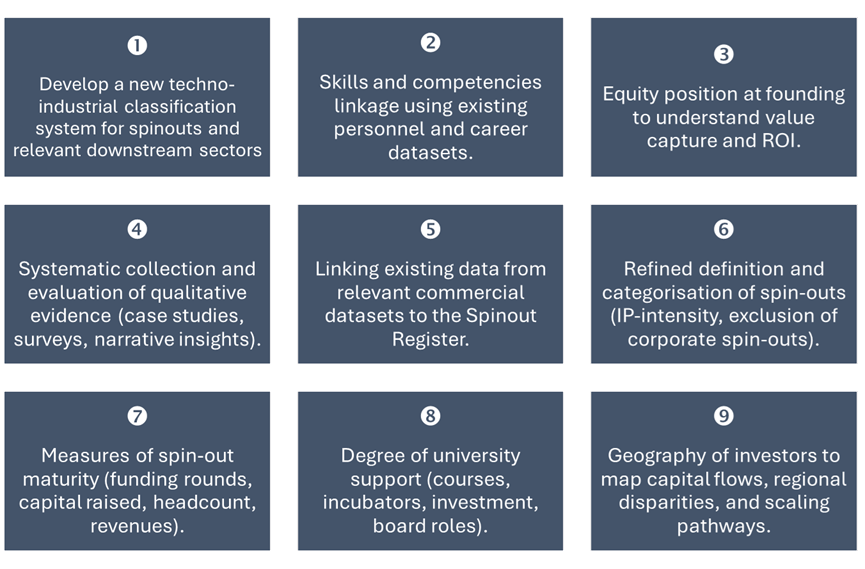
This blog reflects on the recent transformation we have seen in national spinout data over the last 3 years, with novel data developments expanding analytical possibilities, many driven through Research England’s national development programme for knowledge exchange metricsi. Building on the insights and momentum from the inaugural Spinout Data Summit, our call to action identifies nine key strategic initiatives and encourages actors across the spinout ecosystem to leverage the recently-developed UK Spinout Register to build a richer, more connected data landscape on university spinouts. To target specific initiatives, it introduces a new report – Towards a Roadmap for Spinout Data and Evidence - and calls on the sector to unite behind a shared future for national spinout data:
Download this call to action as a pdf
Thin on the (spinout data) ground
In pursuit of high-value growth, university spinouts are increasingly recognised as a key route for knowledge translation: a distinct high-potential asset class with the potential for wealth creation, and ability to drive our places, sectors and organisations to be more innovative and productive.ii
Yet until very recently, the national data and evidence base underpinning UK university spinouts was surprisingly thin. Many across the system were well-placed to see first-hand the remarkable companies coming out of our universities: Oxford Nanopore, Exscientia, Paragraf, Ultraleap to name a few… But beyond a handful of well-known success stories, it was difficult to confidently answer simple strategic questions about the national spinout portfolio and pipeline: How many are there? What pathways to success do they follow? How long do they survive?
A handful of relevant data, to begin answering these questions, existed, but was constrained to high degrees of aggregation, small samples and anecdotal evidence; or, isolated in silos, dispersed across universities’ own records, HESA’s HEBCI survey, Companies House and a range of commercial datasets.
To help drive more spinouts to success, it was evident the UK needed better national data, greater transparency on what is and is not counted, and a system wide commitment to developing meaningful insight into spinout ecosystem health, functioning and performance.
Register-ing more meaningful data
In this respect, a significant step-change was initiated with the Spinout Registeriii. Conceived and delivered by a tripartite consortium of Research England, HESA and UCI, aligned with the recommendations of the Tracey-Williamson Spinout Review (2023)iv, the Register was designed to be the canonical record of the population of UK university spinouts. It was intended to provide both a durable foundation and a springboard for new types of spinout-related datasets, analyses, dashboards and other types of data products.v
Still in the early days of its implementation, the Spinout Register continues to mature in quality, as is typical with any novel data. However, following the publication of its first iteration in 2025, accredited as official statistics in development, its value was immediately evident in the confidence it brought to system-level discussions. International interest has also followed, with other countries following the UK’s lead; for example, Algeria published its own spinout register in early 2026.vi
Opportunity for insight
As envisaged, the Spinout Register quickly underpinned a wave of new analyses, speaking to various strategic needs across the system, be it developing strategic ecosystem insights, strengthening inward investment propositions, or meaningfully benchmarking performance for strategic learning. To name a few examples:
• UCI’s report - Powering Ideas to Innovation – evidenced the significance of university spinouts to driving entrepreneurial activity and attracting investment in key strategic sectors for the UK plcvii;
• Centre for Cities published Town & Gown, a report exploring the regional dynamics of spinout migration patterns, and the implications for spinout survivalviii;
• Tony Hickson’s Review of University-Investor links was largely grounded by a deep pool of evidence, using the Spinout Register as its starting point.ix Through comparative analyses of the UK’s performance against our international counterparts, the review’s findings demonstrated the UK’s core successes, as well as areas to strengthen, to further cultivate a dynamic ecosystem around our startups and spinoutsx; and,
• Midlands Innovation has recently leveraged the Spinout Register to showcase the unique strengths of the Midlands ecosystem, its assets, research base, talent, and investment attraction power.xi
What strategic needs might you be able to leverage the Spinout Register to support?
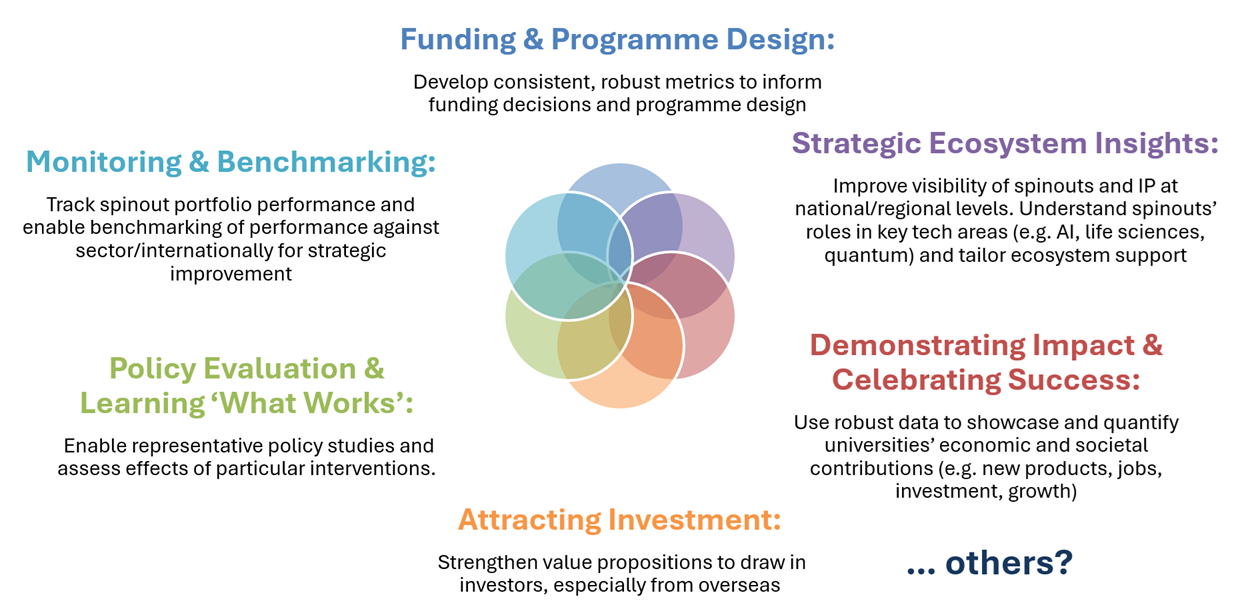
The spinout system now has the solid data foundations it desperately needed: the fundamental plumbing, connecting up the previously siloed efforts, to keep the ‘analytical taps’ on.
Charting the road ahead at the UCI-RE Spinout Data Summit
What is quite clear though is that the Spinout Register does not mark the end of the spinout data journey. Instead, it reveals the full scale of the opportunity ahead. The questions the sector is facing have now evolved beyond simple counts of companies, to deeper understanding of distinct pathways, and richer storytelling about the imprint these companies make on our economy and society. An ecosystem up until now described by lagged annual indicators now requires real-time intelligence to keep pace.
There is now strong momentum to build from the transformation enacted by the Spinout Register, to further accelerate the strengthening of spinout data and evidence. But, without a shared sense of evidence needs, priorities and sequencing, there remains a risk that well intentioned efforts across the domain could revert to fragmentation, duplication or misalignment.
It was in this context that UCI and Research England convened the sector at The Spinout Data Summit, to celebrate progress and connect spinout data experts, creating space for open discussion on future needs and the shared paths to achieving them.
We challenged directors of university innovation offices, funders, policymakers, ecosystem enablers and data specialists to come together for a workshop to prioritise what the next steps should be and begin to chart these into a strategic roadmap.
The specific goals and aims of the workshop were the following:
- Identify and agree the most important current and future opportunity spaces that national-level spinout data and evidence could support.
- Based on the key opportunity spaces, identify specific improvements and enrichments to national spinout data, and where key gaps that currently exist could be filled (via improvements to the Spinout Register or via other routes).
- Prioritise the various suggested improvements, enrichments & data gaps in terms of what would be most valuable and feasible to take forward.
Highlights from The Spinout Data Summit, 12 November 2025

Towards a roadmap
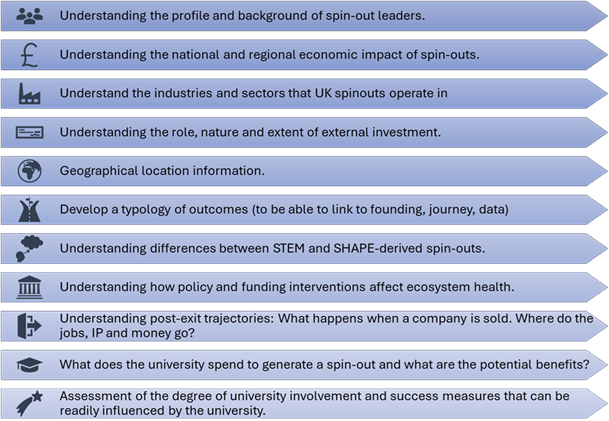
Our new commissioned report - Towards a Roadmap for Spinout Data and Evidence - provides the navigational chart for this next phase.xii Authored by the workshop facilitators, IfM Engage, experts in the application of strategic roadmapping for policy and industrial uses, its purpose is not to prescribe the single next step, but to articulate a shared, sector-aligned view of the priority opportunity spaces - the topics where enhanced national spinout data can deliver the most value.
The report identifies eleven opportunity spaces:
It also sets out nine strategic initiatives, arising from the workshop discussions and fully detailed in the report, that address the chosen opportunity spaces and could significantly strengthen the national spinout data ecosystem: These initiatives span developing a richer set of characteristics about the spinouts themselves, as well wider drivers of success and measures to capture these. Crucially, these initiatives focus on harmonisation to new definitions, interoperability and data linkage – extracting greater value from existing sources through better linking opportunities — rather than increasing statutory reporting requirements for institutions.
Innovating spinout data for future
What is pleasing is that some of this work is already underway. Through Research England’s national development programme for knowledge exchange metrics, important progress continues to be made in improving the quality, connectivity and usability of spinout data and other commercialisation data.
UCI is leading the charge here as the unit continues to pioneer new ways to develop national-level data, insights and metrics that aim to meaningfully capture what good looks like for university commercialisation. Through our close partnership with Research England, we continue to advise them on how these concepts can be suitably incorporated into their approaches.
For example, UCI are currently working with partners, Glass.AI and the Centre for Business Research, to pilot novels ways of utilising web-based information to provide richer insight on spinout companies. This includes enriching core spinout data with: a bespoke techno-industrial classification system for university spinouts; founder characteristics; and, signals of company development that better capture less-conventional pathways. It is encouraging that these latest projects resonate with several of the strategic initiatives identified by our convened group of spinout data experts. And as such, we will aim to ensure data outputs from this work are published, where possible, to enable others across the sector to use, and further develop upon, for their own strategic needs and purposes.
Building momentum - A call for action
Our direction is, of course, promising. The set of initiatives proposed, builds towards a roadmap, but is not intended to be a static plan. It is designed to provide an initial set of aligned aims that may evolve as the spinout data landscape matures further, as data linkage capabilities improve, and as policy priorities shift. Nevertheless, it provides the sector with a shared starting point for coordinated action.
We implore anyone with a stake in the spinout ecosystem to consider how they might contribute to the next phase of data developments, either to support their own aims and/or those of others. Where these efforts align with the prioritised opportunity spaces and initiatives our expert group identified, there is real opportunity to make meaningful progress in improving the quality, coverage and value of national spinout data.
The national ambition underpinning this work is clear. We must continue to ensure the UK reaches its full potential to create and scale world class spinouts. To do this, we must develop the data and evidence base needed to understand what drives their success — and translate this into better policy, better investment decisions, and stronger outcomes across the whole innovation system.
We would be delighted to hear from those embarking on steps towards this goal, to share learnings and collectively explore what is possible.
With thanks to …
UCI are hugely grateful to all those who have engaged with - and continue to support – the development of the Spinout Register, helping to ensure it remains a high-quality national data asset that can enable richer insight on university spinouts. In particular, we extend our thanks to those who generously contributed their time and expertise during the workshop at the Spinout Data Summit’s workshop. We hope the findings presented here and in the commissioned report accurately reflect your insights and perspectives.
We are also very grateful to IfM Engage for expertly facilitating the workshop and developing the accompanying summary report, and to Research England (UKRI) for continuing to fund UCI’s work and for leading the national knowledge exchange metrics programme—setting the pace for innovative data developments in commercialisation and knowledge exchange.
References:
i Further information about Research England’s national development programme for knowledge exchange metrics is available here: https://www.ukri.org/councils/research-england/our-funds-for-research-and-knowledge-exchange/knowledge-exchange-data-and-metrics/
ii Ulrichsen, T.C. and Kelleher, L. (2025). University knowledge exchange for economic growth: A framework for guiding understanding and evidencing success. UCI Policy Briefing. Policy Evidence Unit for University Commercialisation and Innovation (UCI), University of Cambridge. https://www.ifm.eng.cam.ac.uk/uploads/UCI/knowledgehub/documents/UCI_UniKE_and_growth_framework_report_Oct2025_vPublished.pdf
iii Latest Spinout Register data available at: https://www.hesa.ac.uk/data-and-analysis/business-community/spin-out-register
iv Department for Science, Innovation and Technology and HM Treasury (2023) Independent review of university spin-out companies. Available from : https://www.gov.uk/government/publications/independent-review-of-university-spin-out-companies
v Miller, J., Ulrichsen, T.C., Bamford, E. (2024). Improving Spin-out Data with the Spin-out Register: Design Principles and Opportunities. https://www.ukri.org/wp-content/uploads/2024/09/RE-200924-Spin-out-Register_Visioning-Report_RE-and-UCI.pdf
vi Heles, T. (2026) Algeria unveils national spinout register, maps 388 startups at launch. https://thenextleap.is/news/algeria-national-spinout-register/
vii Ulrichsen, T. C., and Miller, J. (2025). Powering Ideas to Innovation: The significance, structure and dynamics of the UK university spinout ecosystem. Policy Evidence Unit for University Commercialisation and Innovation (UCI). https://doi.org/10.17863/CAM.119020
viii Johnson, R. and Lin, X. (2025) Town and gown: The role of universities in city economies. https://www.centreforcities.org/wp-content/uploads/2025/09/Town-and-gown-briefing-September-2025.pdf
ix Ulrichsen, T. C. (2026). Investing in Success: A quantitative analysis of the structure, dynamics and links within the UK university spinout and investor ecosystem. A Technical Report for Research England. https://www.ukri.org/wp-content/uploads/2026/01/RE-200126-Ulrichsen-InvestinginSuccess-Report.pdf
x Research England (2026). Deepening University-Investor Links: A review by Tony Hickson for UK Research and Innovation. https://www.ukri.org/publications/deepening-university-investor-links/
xi Midlands Innovation (2026). University innovation in the Midlands: A new era of commercialisation. https://midlandsinnovation.org.uk/wp-content/uploads/2026/04/University-Innovation-in-the-Midlands_A-New-Era-of-Commercialisation.pdf
xii IfM Engage (2026). Towards a Roadmap for Spinout Data and Evidence. https://www.ifm.eng.cam.ac.uk/uploads/UCI/knowledgehub/documents/2026_Roadmap_SpinoutData_Final_Published.pdf