

New paper charts 60 years of innovation in manufacturing engineering education at Cambridge
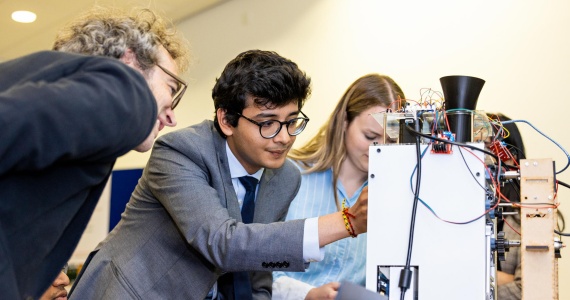
A new working paper from the Institute for Manufacturing (IfM)’s Centre for Technology Management follows six decades of manufacturing engineering education at the University of Cambridge, highlighting how distinctive, experiential approaches to teaching have evolved to meet changing industrial and societal needs.
The ‘Manufacturing engineering education at the University of Cambridge: An illustrative case of long-cycle responses to contextual change’ working paper brings together authors from across the IfM’s teaching programmes to reflect on the past, present and future of manufacturing education at Cambridge, and to consider how educational approaches must adapt to future industrial needs.
The paper outlines how the IfM’s programmes have continually adapted since the 1960s, shaped by shifts in the global manufacturing landscape, UK education policy, and advances in technology and teaching methods. Across postgraduate, undergraduate and executive education, the IfM has maintained a consistent commitment to experiential, project-based and industry-engaged learning.
“A common feature of all the IfM’s programmes is a pedagogy that merges technical skills, industrial experience and understanding, communication skills, and the ability to clarify real life situations through industrial engagement and real time projects,” says lead author and Head of the IfM, Tim Minshall. “The paper discusses the evolution of three programmes (post-graduate, undergraduate and executive education) and reflects on emerging challenges and opportunities.”
Sixty years of experiential learning
The paper charts the development of the IfM’s three core taught education pathways:
- A taught postgraduate qualification, that began as the pioneering Advanced Course in Production Methods and Management (ACPMM) in the 1960’s and evolved into today’s MPhil in Industrial Systems, Manufacture and Management (ISMM).
- The Manufacturing Engineering Tripos (MET), an undergraduate MEng pathway offered for the final two years of a Cambridge engineering degree.
- The IfM Engage executive education portfolio, created to transfer IfM research, methods and tools to industry, government and universities.
The paper describes how the programmes have evolved, shaped by eight educational innovations including learning from real industrial projects, developing strong industrial awareness, integrating ‘Big M’ manufacturing thinking, and creating structured opportunities for reflection, transferable skills development and theory-practice comparison.
Over the decades, the curriculum has broadened significantly, from an early focus on production engineering to today’s integrated understanding of manufacturing as a complex system influenced by globalisation, sustainability, technology evolution, industrial design, and supply chains.
Preparing for the future
Looking ahead, the paper outlines key future challenges for manufacturing education. With a changing global context, the authors anticipate the need to evolve in response to a wide range of drivers, including the impact of AI, increasingly unstable geopolitics, rising demand for hybrid and flexible learning, and the announcement of UK’s industrial strategy.
The IfM is considering responses such as a part-time ‘Master’s in Manufacturing and Industrial Leadership’ for those who have a non-traditional educational pathway and new professional development offerings for industry-based technology leaders and innovation champions.
“There is also a major opportunity arising from the changing educational and industrial context,” says Tim. “Education at the Point of Need’ or ‘Just-In-Time-Training’ is going to be transformative for manufacturing education organisations. To remain relevant to the evolving needs of manufacturing industry, educational organisations like the IfM must find a way to develop or access the capabilities for the increasingly demanded approaches as part of their portfolio of educational activities.”
A model for long-term educational innovation
While recognising that Cambridge’s environment is distinctive, the authors argue that lessons from this long-term evolution are relevant to institutions worldwide seeking to prepare the next generation of manufacturing leaders. The IfM’s experience illustrates the value of staying flexible, attentive to industrial signals, and open to new modes of delivery and assessment.
Reflecting on the findings, Tim summarises, “Experiential education has endured because it equips students to deal with ambiguity, complexity and real-world industrial challenges. To remain relevant in a rapidly changing world, we must continue to evolve, drawing on research insights, responding to the needs of learners and employers, and maintaining deep engagement with industry.”
Read the full working paper: https://www.repository.cam.ac.uk/items/e45f643e-9ae7-479c-a8f8-84007eaceabd