New national framework sets out vision for Materials 4.0 in the UK

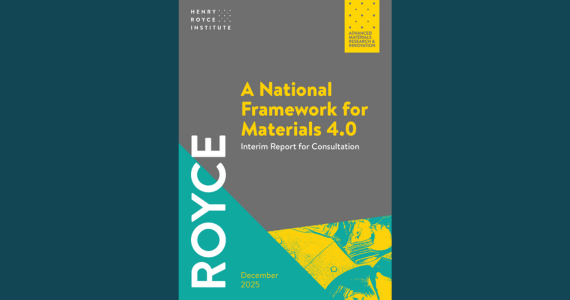
The Henry Royce Institute has published its Interim National Framework for Materials 4.0, setting out a shared way of thinking about how digital technologies can transform the UK materials landscape. Supported by IfM Engage, the framework provides a common language and structure to help align activity across the materials community as it moves towards a more digitally enabled future.
Materials 4.0 is defined in the report as an umbrella term for the ongoing transition to a digitally enabled materials sector, spanning the full materials lifecycle from discovery and development through to manufacturing, use and end-of-life. The concept was identified in Royce’s National Materials Innovation Strategy as a core cross-cutting theme, with relevance across all materials sectors and value chains.
The interim framework responds to a growing need for coherence in a rapidly evolving landscape. While digital tools such as data platforms, modelling, artificial intelligence and automation are already being applied in materials research and industry, activity has often been fragmented. The framework aims to provide a shared reference point to support coordination, investment and collaboration across academia, industry and government.
To test and illustrate the framework, the report draws on a series of sector-spanning use cases, including composite materials for wind turbine blades, battery materials, steel and sustainable packaging. These examples demonstrate how coordinated digital approaches can accelerate innovation, improve productivity and support UK leadership in areas such as clean energy, sustainable manufacturing and advanced engineering.
IfM Engage, the knowledge transfer arm of the Institute for Manufacturing (IfM), led a consortium of companies including ,Perspective Economics, Urban Foresight and Frazer-Nash Consulting, and worked closely with the Henry Royce Institute to develop the framework. The team brought experience in structuring cross-sector engagement, coordinating input from across the community to help build a UK-wide picture of the Materials 4.0 landscape.
This work included mapping existing infrastructure, capabilities and initiatives using a combination of quantitative and qualitative data collection and analysis; identifying opportunities arising from large-scale adoption of Materials 4.0 approaches; and highlighting strengths, gaps and barriers across technical, organisational and regulatory dimensions. International benchmarks and lessons were also used to inform the framework and position the UK within a global context.
Nicky Athanassopoulou, Head of the Solution Development team at IfM Engage, said, “This project brought together a wide range of perspectives from across the materials ecosystem. By combining detailed industrial insight with input from across the community, we were able to help create a framework that is both practical and ambitious, and that can support informed decision-making as Materials 4.0 continues to develop.”
The Interim National Framework for Materials 4.0 is intended as a foundation for further consultation and refinement. The next phase will build on this work to develop more detailed guidance, priorities and actions, supporting the UK materials community as it moves towards a more connected, digitally enabled future.
Find out more and download the report: https://www.royce.ac.uk/news/royce-launches-national-framework-to-accelerate-the-materials-4-0-revolution/