

MET Design Show 2026
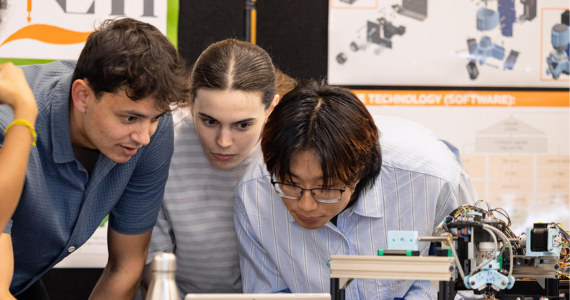
The 2026 Manufacturing Engineering Tripos (MET) Design Show showcases an exciting collection of innovative products developed by third-year MET students at the Institute for Manufacturing (IfM).
The MET is an option for the final two-years of a Cambridge engineering degree, combining technical excellence with the management, business and leadership skills needed to address real-world challenges. As part of the programme, student teams undertake a major year-long design project, developing a new product with genuine commercial potential.
Starting with the identification of a customer need, students conduct market research, generate and evaluate original design concepts, and build a comprehensive business plan to support their proposed solution. The resulting projects demonstrate not only technical creativity and engineering expertise, but also an understanding of market opportunities, user requirements and commercial viability.
These projects are presented at the annual MET Design Show. In the morning, students pitch their designs to an audience of IfM colleagues and invited guests. In the afternoon, the projects are exhibited for faculty, researchers, staff and visitors, offering an opportunity to explore the designs and engage directly with the teams behind them.
The projects featured below represent a diverse range of ideas, technologies and solutions, reflecting the creativity, ambition and entrepreneurial spirit of this year’s MET cohort.
Helicos - Automated Casting. Better Outcomes.
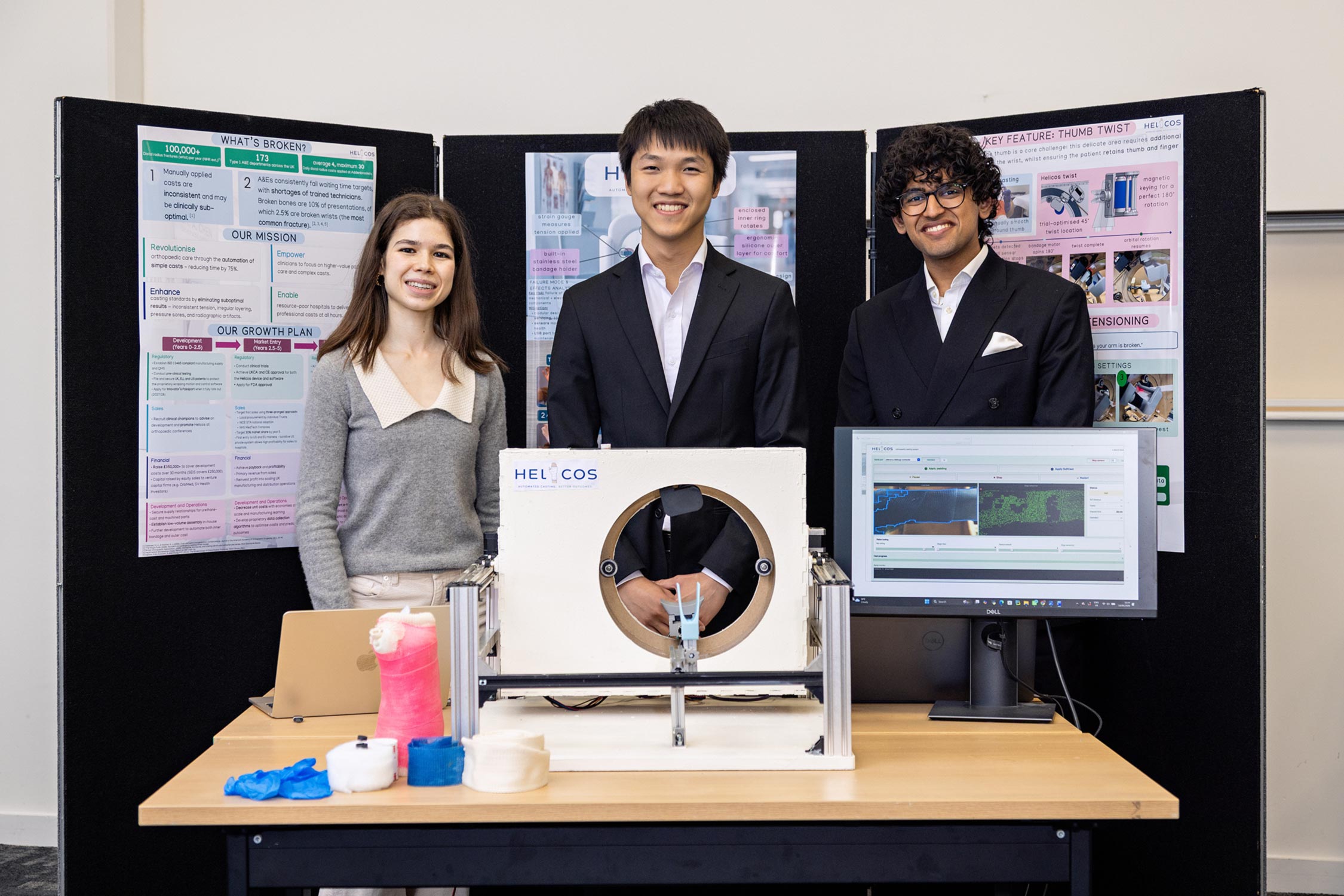
Helicos saves time in the plaster room with a clinically optimised, automated casting machine for short-arm casts.
Traditional orthopaedic casting is a manual, labour-intensive craft that has changed little over the decades. In the UK alone, approximately 100,000 distal radius (wrist) fractures are treated annually, yet manual application can frequently lead to clinically suboptimal results. Inconsistent bandage tension, irregular layering, and a lack of standardised methods can result in pressure sores, poor perfusion, and radiographic artifacts that may hide small fractures during follow-up imaging.
Helicos is an automated casting system designed to bring robotic precision to fracture immobilisation. After a clinician applies the initial stockinette and padding, the limb is stabilised within the device. Our dynamic wrapping system combines orbital rotation with precise linear motion to create a perfect cast tailored to the patient’s specific anatomy. Using distance-sensing technology to track the limb’s profile from elbow to fingers, the system automatically adjusts rotational and linear speeds. This ensures a consistent 50% overlap and constant bandage tension for every patient. Control is managed through an intuitive touchscreen GUI, allowing the clinician to monitor application.
Helicos offers a paradigm shift in orthopaedic care, perfecting routine cast application, enabling clinicians to focus their limited time on complex cases. In an ever-stretched NHS environment, Helicos promises to modernise the plaster room.
Team: Keshav Kedia, Bryan Bukoh and Amelie Gadsby
Shuffle Royale
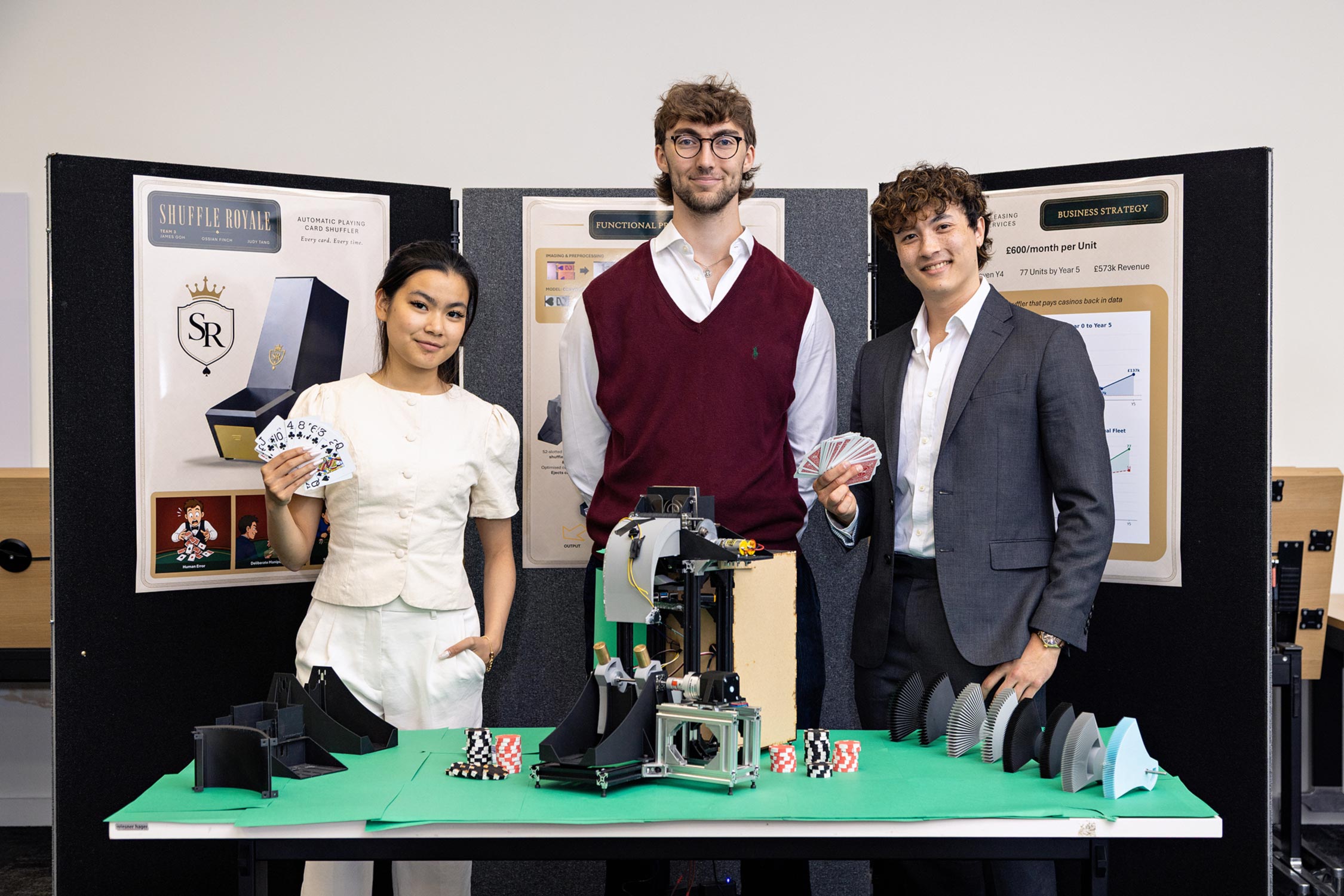
An automatic playing card shuffler with integrated computer vision for individual card recognition and control, designed for casinos and enthusiasts with configurable shuffle randomness.
The Shuffle Royale is an intelligent card shuffling machine that mechanically processes a deck of cards in under 60 seconds, identifying each card with integrated computer vision before redistributing them in a configurable order. Designed with casino-grade applications in mind, the system combines an innovative mechanical design with embedded software to deliver a level of deck control, reliability, and auditability that no existing product currently offers at our proposed price point.
Casino card shuffling has long been a source of operational inefficiency and security vulnerability. Manual shuffling is inconsistent, time-consuming, and susceptible to human error or deliberate manipulation. Existing automated shufflers either lack the intelligence to detect deck integrity and provide verifiable results, or have prohibitively high price tags.
The Shuffle Royale addresses this market gap with a novel rotary arc mechanism that uses gravity-assisted indexing to sort cards into discrete bins, driven by a gear-reduced stepper motor for precise positional control. Single cards are fed into the arc via a double-tapered funnel by a pair of rollers and an octagonal kicker that separates them at a controlled rate. A Raspberry Pi Camera module captures each card at the input, and a template matching algorithm identifies rank and suit in real time, enabling detection of incomplete or corrupted decks.
Compared to existing commercial shufflers such as the DeckMate 2, the Shuffle Royale’s simpler design delivers comparable performance at less than half the price point, with an open software architecture that allows shuffle algorithms to be audited and customised by operators. The result is a device that does not merely automate shuffling, but transforms it into a transparent, controllable, and accountable process.
Team: Ossian Finch, James Goh and Judy Tang
Ariadne
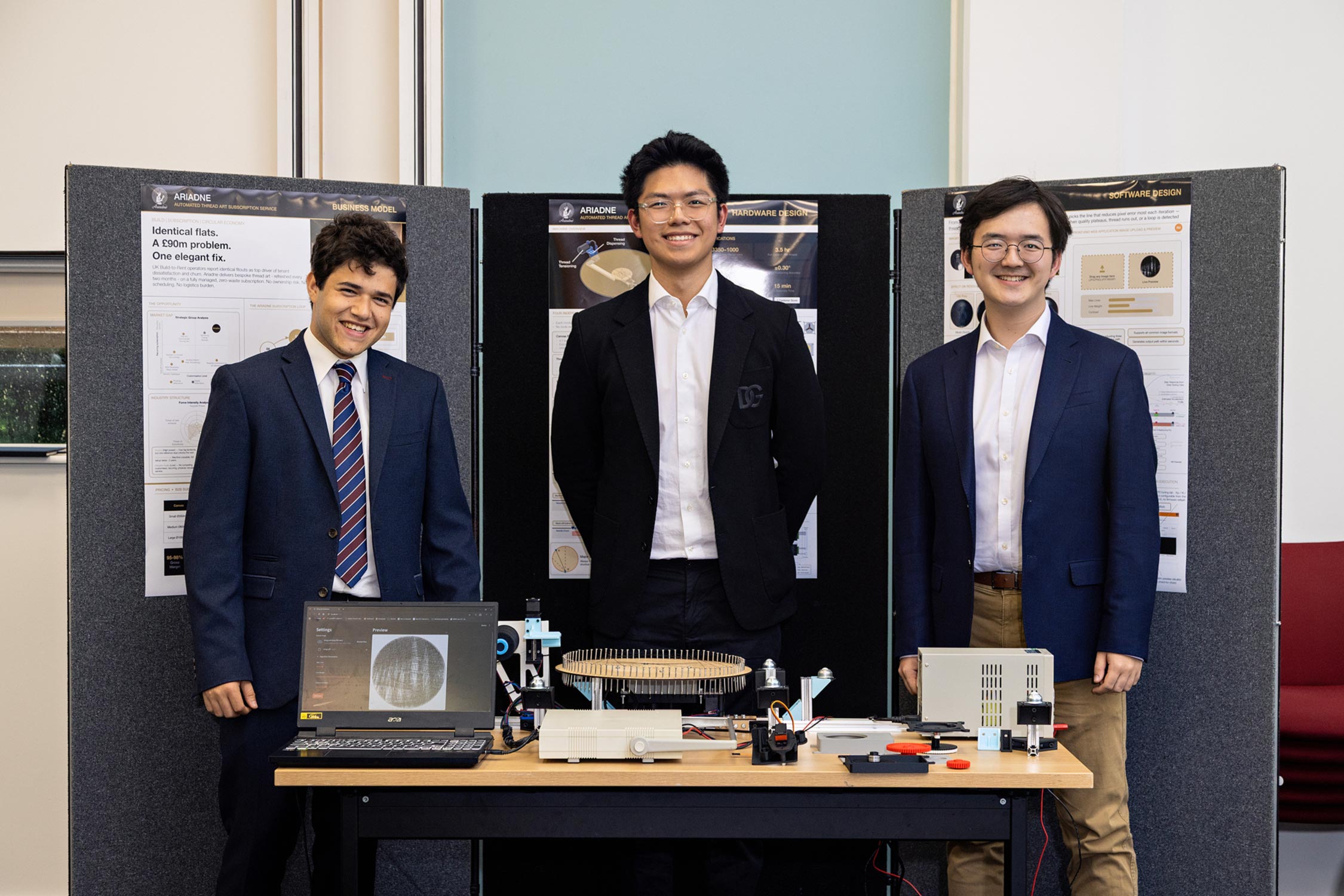
A subscription that puts a fresh piece of customised wall art into a customer’s space every two months, then quietly takes it back at the end of the cycle.
Most of us spend our lives in rooms that do not change very much. The same flat, the same office, the same walls, week after week. Build-to-Rent landlords have a common problem with this: identical-looking flats are a known drag on tenant retention and a real source of turnover. We thought we could do something about it, and make the solution properly personal at the same time.
Ariadne is what we built. A new piece arrives, the old one goes back, and the customer never has to think about last season’s art.
What makes Ariadne different is the upload. The customer hands us any image they like: a family photograph, a logo, a favourite drawing. Our algorithm translates it into a continuous thread pattern that the machine winds on a circular pin board. The result is a personal mark in a space that usually does not let people put one. Customers who would rather not upload can pick from a curated library that grows every month.
The loop runs quietly in the background. When we collect an old piece, the canvas comes back to us, the thread is stripped off, and the canvas is reused for the next design. A single canvas can host dozens of pieces over its life. Customers get a quarterly summary of what their service has saved if they want it for their sustainability reporting.
We are starting with UK Build-to-Rent landlords, who already have 146,700 flats built and another 108,000 in the pipeline. The sector is consolidating fast, so one good contract puts the service into thousands of homes at once. From there, the same service extends to co-working operators, hotel groups and design-led cafés.
Our aim is simple. Make a wall feel personal, then keep it feeling that way.
Team: Ran Xin, Daniel Bohm and Jay Yu
TetraWeave
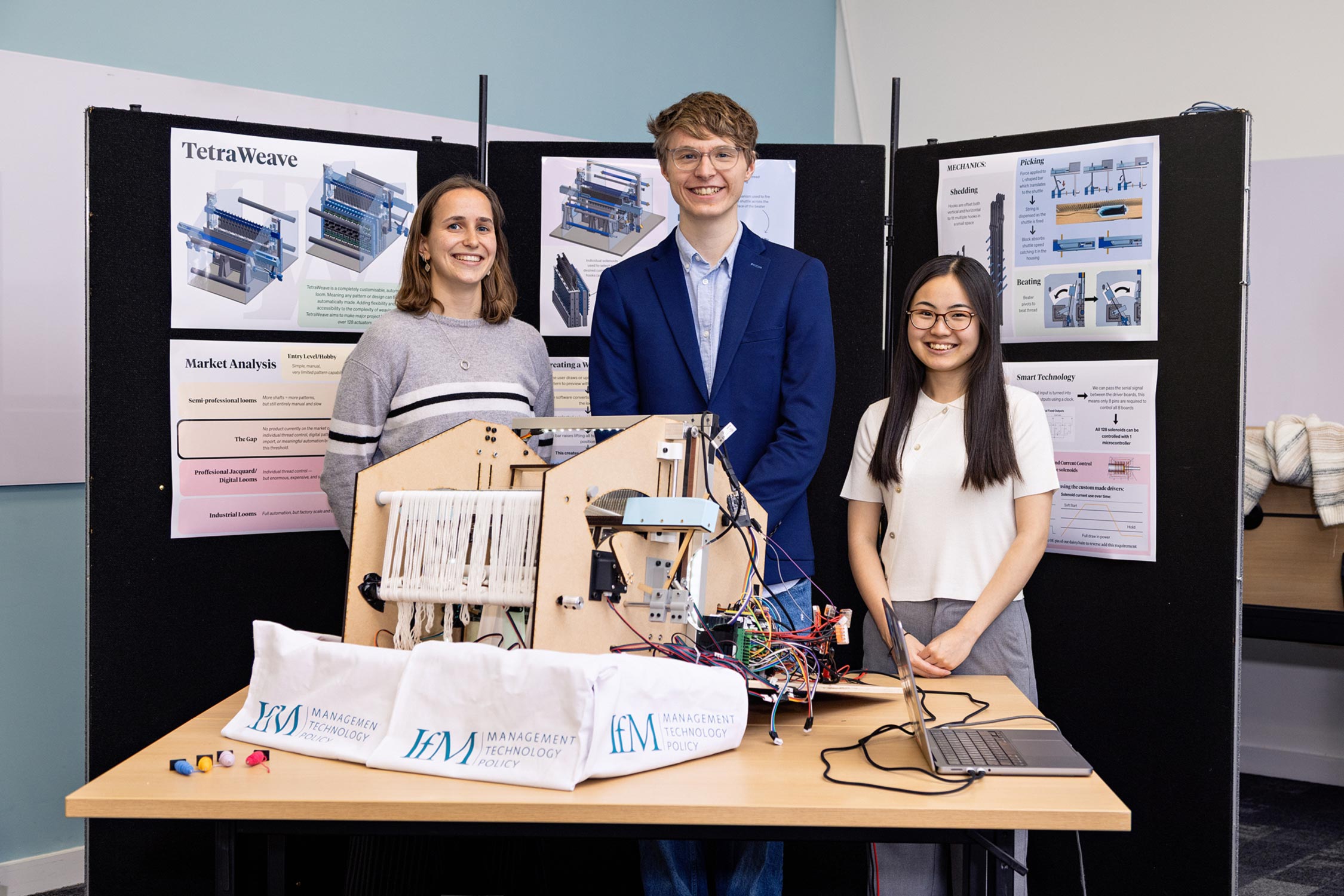
TetraWeave is a completely customisable, completely automated loom. Meaning any pattern or design can be automatically made. Adding flexibility and accessibility to the complexity of weaving, TetraWeave aims to make major project history using over 128 actuators.
Currently there exists two extremes of weaving: delicate and laborious hand weaving and expensive high volume industrial scale weaving that requires extreme capital. TetraWeave aims to fill this gap by creating the affordable yet versatile, automatic loom. The innovation here is applying modern technology and powerful design processes to unlock performance at a new price point. Now, designers, hobbyists and businesses at all scales can prototype new concepts rapidly with low time and capital demands.
Weaving is a historically innovative and complex machine; tetraweave builds on years of loom development with a pivot towards high end capabilities at a more accessible scale. The customised loom allows for full control over each and every thread, allowing for unlimited design options. All considerations have been taken to make this loom as easily accessible as possible for the average user with features to reduce set up time, ease of maintenance and fully integrated user interface.
The desired product is drawn, converted into a suitable pattern in the user interface and dictates the necessary movements for the loom. The system contains 3 main elements which allow for individual threads to be selected, threaded and compacted to give a stable weave. The elements are integrated to perform a reliable cycle that iterates automatically over and over to complete the fabric.
With support for up to 128 threads in width and unlimited length, TetraWeave scales to your ambition. Create small swatches, long scarves, or full clothing panels — all on the same machine.
Team: Caragh Haspel, Leo Hammett and Reiko Fujiyoshi
Origunmi
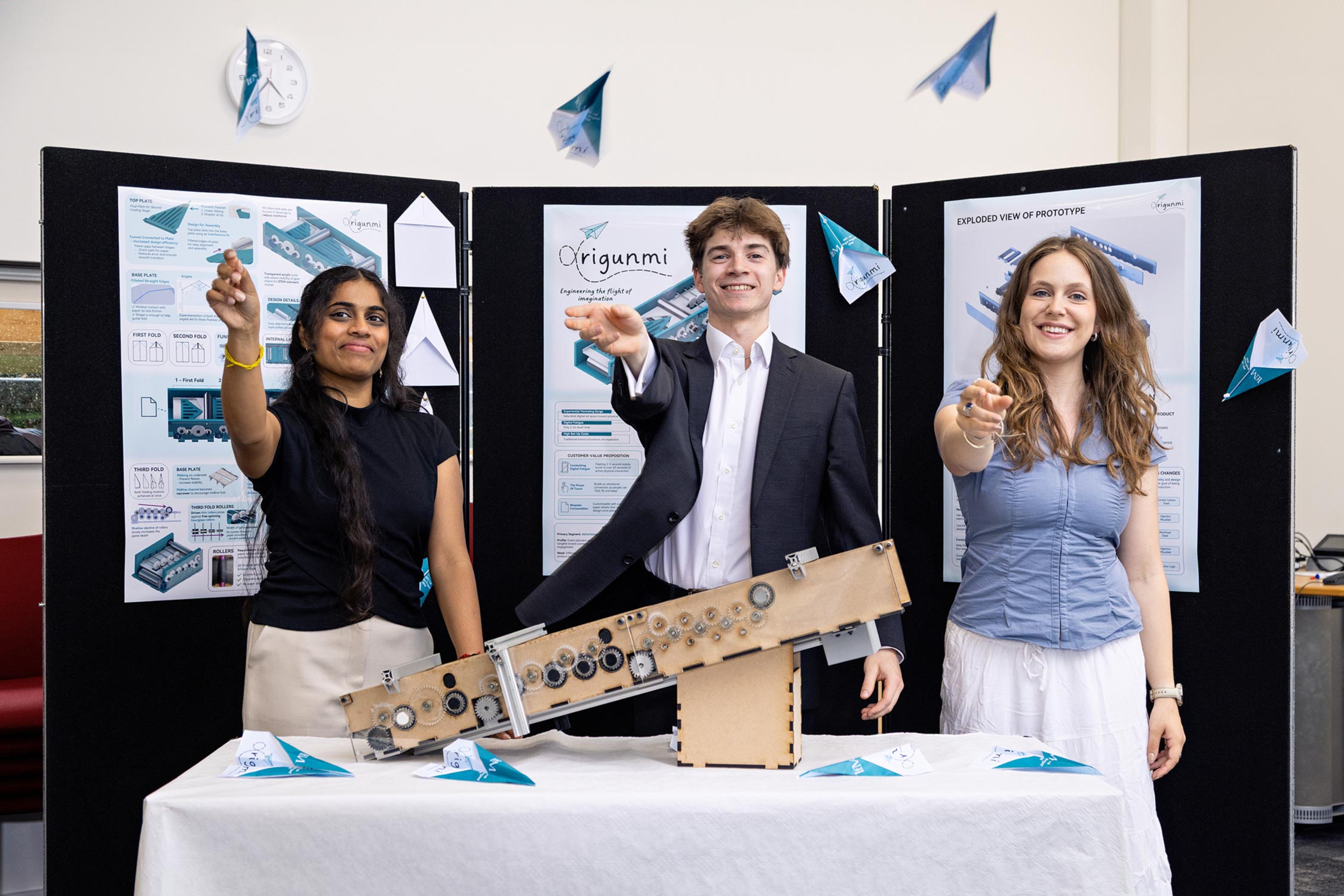
Engineering the flight of imagination. We build the technology that folds, fires, and follows through on your biggest ideas.
Origunmi is an innovative, desktop-sized machine tool engineered to automate the folding and firing of paper aeroplanes. Designed to bridge the gap between physical engagement and modern technology, Origunmi targets two distinct market opportunities: interactive STEM education and experiential advertising.
- As an educational platform, Origunmi serves as a fun device that excites students about manufacturing design and STEM fields, inspiring a future generation of innovators.
- Simultaneously, it provides advertising agencies with a powerful tool to break through digital fatigue. Origunmi creates high-impact, physical and branded items that consumers can touch, fly and keep, leveraging emotions and high-visibility engagement to deliver a longer-lasting impression.
The core product architecture is highly adaptable and built on a modular system. Users can easily customise the machine’s mechanical capabilities by swapping individual conveyor elements in and out. This allows the machine to achieve a variety of different folding patterns and aerodynamic designs, ensuring the physical hardware remains dynamic, engaging and versatile over time.
Origunmi redefines the traditional hardware model by operating as a fully integrated product-service system. The core machinery is paired with a supply of specially designed paper, featuring pre-printed designs. These designs are mapped to the mechanical folding process so that the final 3D aeroplane beautifully reveals hidden branding. Beyond the hardware, a cloud-connected digital platform expands the product into a collaborative ecosystem. Here, a global community can exchange custom folding patterns and share designs. This synergy of physical modules, custom media and digital connectivity ensures that Origunmi delivers ongoing interaction and evolving value.
Ultimately, Origunmi redefines boundaries, transforming a simple piece of paper into a unique platform for education and engagement.
Team: Annabel Gray, Owen Dyson and Lithikga Gobi
n-Grave
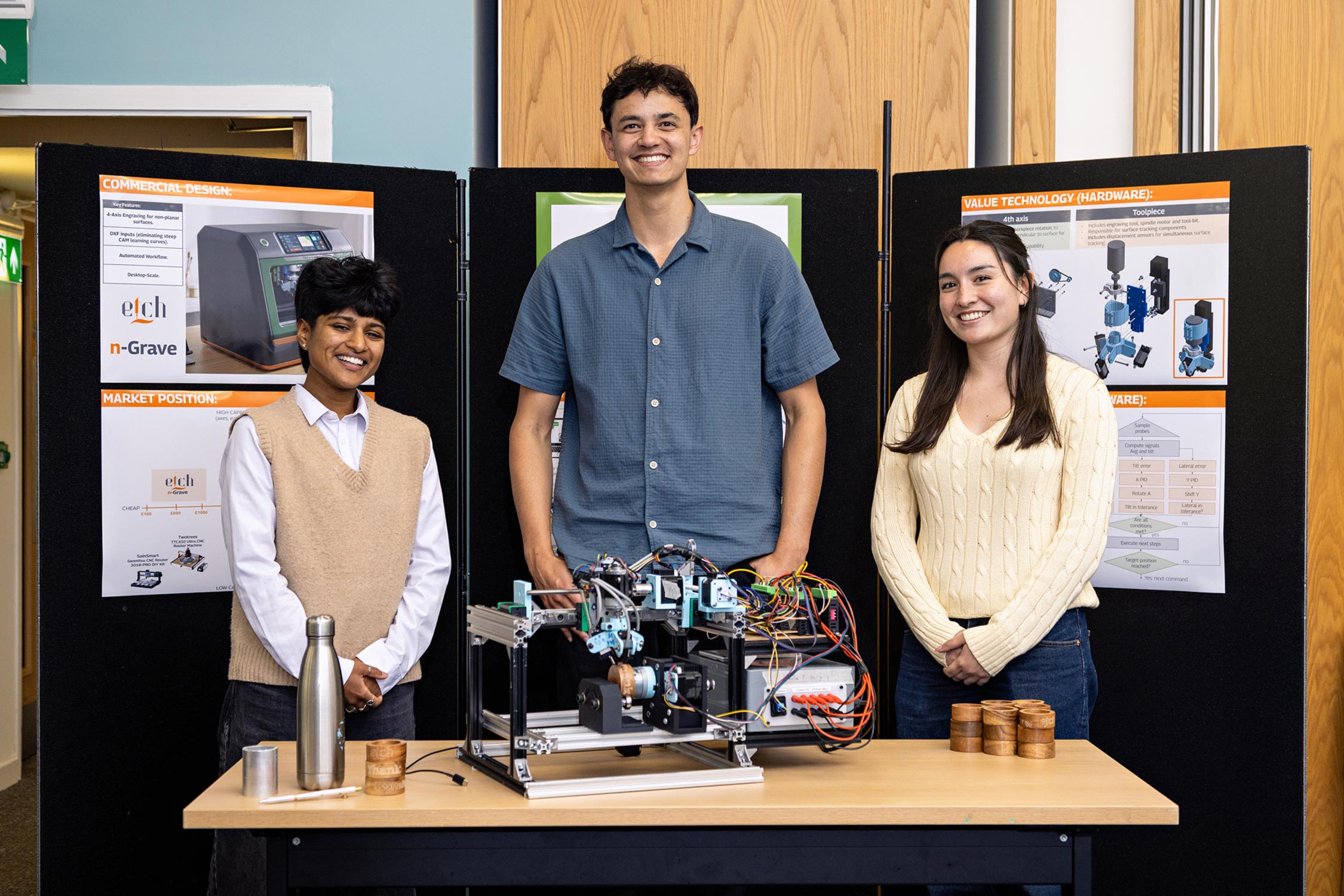
The n-Grave is a desktop 4-axis engraver that automates etching on cylindrical and curved surfaces. By converting simple DXF files and utilizing real-time surface probing, it eliminates steep CAM learning curves and unsteady manual engraving for hobbyist creators.
The growing market for personalised goods on platforms like Etsy has created a great opportunity for creators to scale their customisation capabilities from home. However, small-scale entrepreneurs and hobbyists face the operational barrier where entry-level desktop CNCs are strictly limited to flat, 3-axis geometries, while more versatile 4-axis machinery remains financially out of reach. This forces makers to rely on imprecise hand tools or navigate the high costs and delays of outsourcing.
The n-Grave aims to help bridge this market gap by bringing automated, high-precision 4-axis engraving directly to the consumer desktop at an accessible price point. Designed to seamlessly engrave on 3-dimensional, curved, and cylindrical surfaces, the n-Grave transitions advanced CNC engraving capabilities from an industrial facility process to a home-office appliance. Crucially, the n-Grave democratises multi-axis machining by eliminating the steep learning curve traditionally associated with complex CAM programming workflows. Instead, users simply upload a standard 2D vector file (DXF). After securing the workpiece using the rotary chuck and adjustable Z-axis fixturing bed, the machine’s integrated software system takes over. Using an automated surface-probing routine, the n-Grave maps the workpiece surface in real time. An iterative feedback loop dynamically translates the digital pattern onto the surface, automatically adjusting the toolpath axes during operation. By combining a rigid, desktop-safe gantry system with simultaneous mapping and engraving, the n-Grave delivers valuable personalisation capabilities with true plug and-play simplicity. It is a core DIY-technology for the next generation of hobbyist creators.
Team: Oliver Muthu, Gauthami Vireswer and Praewa Taylor
Stereomaster 3000
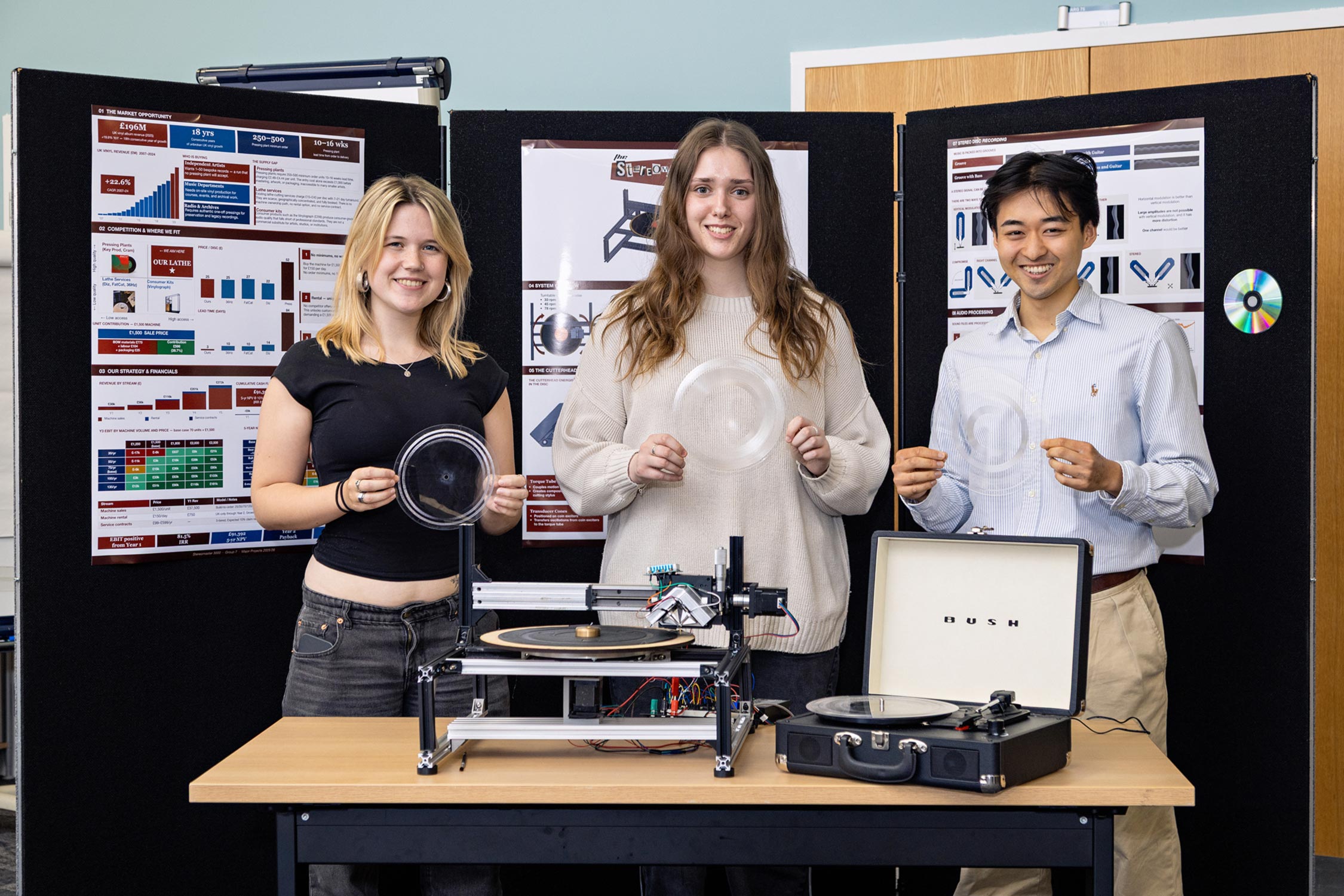
The Stereomaster 3000 is a vinyl record lathe for the people, allowing independent musicians, DJs and audiophiles to make custom vinyl records as easily as burning a CD.
In industry, vinyl records are mass produced by creating stampers and pressing PVC pellets. This is efficient for large-scale production but leaves small artists, DJs and audio enthusiasts unable to make one-off or small batch records. Current alternatives are to pay more than £70 for a business to cut a single custom record, to make their own lathe from scratch, or to purchase one made-to-order from a handful of small-scale specialists. Our product fills this gap for a high quality, off-the-shelf vinyl record lathe. No longer is record production reserved for mastering engineers and record labels. With the Stereomaster 3000, anyone can put their music on vinyl.
The record lathe allows individuals to make 7”, 10” and 12” records for playback speeds of 33, 45 and 78 rpm, only needing to input the sound files they want transferred, giving greater usage flexibility than many of the existing alternatives. Users are then able to cut their own music, playlists, mixes and more from their own home or studio. With the cutting time equal to the length of the recording, users can have a bespoke 12” record ready to play in under an hour.
To achieve the best result, the Stereomaster 3000 is a cutting lathe with a state-of-the-art diamond stylus, giving a higher fidelity output than embossing lathes. The cutterhead takes input from two audio channels to allow for a stereo signal to be compacted into a single groove. Our refined audio processing software can also accommodate bass and treble inputs by equalising the input audio file and consequently altering the channel width and spacing.
Ultimately, the Stereomaster 3000 is designed to support individuals in their endeavour to create, share, and enjoy music, regardless of audience or batch size, so that the art of analogue music is accessible to all.
Team: Amy Jackson, Rick Suzuki and Izzy Carson