A brief history of manufacturing engineering education at Cambridge
Origins: Bridging the gap between university and industry (1954–1965)
The ideas behind the current ISMM course date back to the mid-1950’s. At that time, only around 3% of the UK population attended university, while approximately 40% of school leavers entered lengthy industrial apprenticeships.
British industry was dominated by large companies with extensive training schools that produced engineers who combined technical knowledge with practical experience. University engineering graduates, by contrast, often entered industry with little practical understanding of how products were designed, manufactured and operated.
This gap between academic education and industrial practice would become the driving force behind the creation of the Advanced Course in Production Methods and Management (ACPMM).
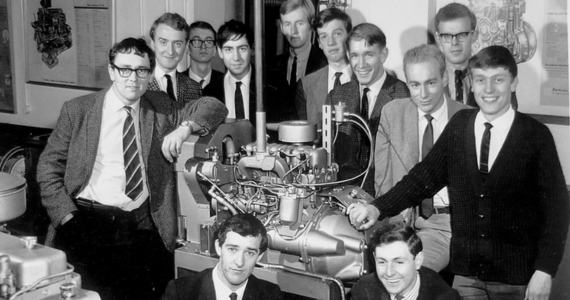
Recognising the need to better prepare engineering graduates for industry, Sir William Hawthorne, Head of Engineering at Cambridge, initiated a 6-week vacation course for 12 undergraduates called ‘Reading Party in Industry’ – a mix of projects, exercises and lectures. This course ran from 1954 to 1956, with one of the early participants being David Newland, who later became the Head of Engineering at Cambridge.
At the end of the programme, there were proposals to expand it into a full-year course, but funding could not be secured.
John Reddaway, a former Cambridge engineer and the first undergraduate to be sponsored by Westland Aircraft, continued to promote the idea when he rejoined the Department of Engineering as a Demonstrator – the first rung on the faculty ladder. This pioneering approach became known as the Reddaway Plan. In 1964, the proposal was considered at a meeting of the Cambridge University Engineers Association, and funding was pledged.
Mike Sharman’s vision
A new member of staff, Mike Sharman, was recruited to the course. A Cambridge graduate who had previously lectured at Hatfield Polytechnic, Mike held strong views about the lack of practical knowledge among engineering graduates.
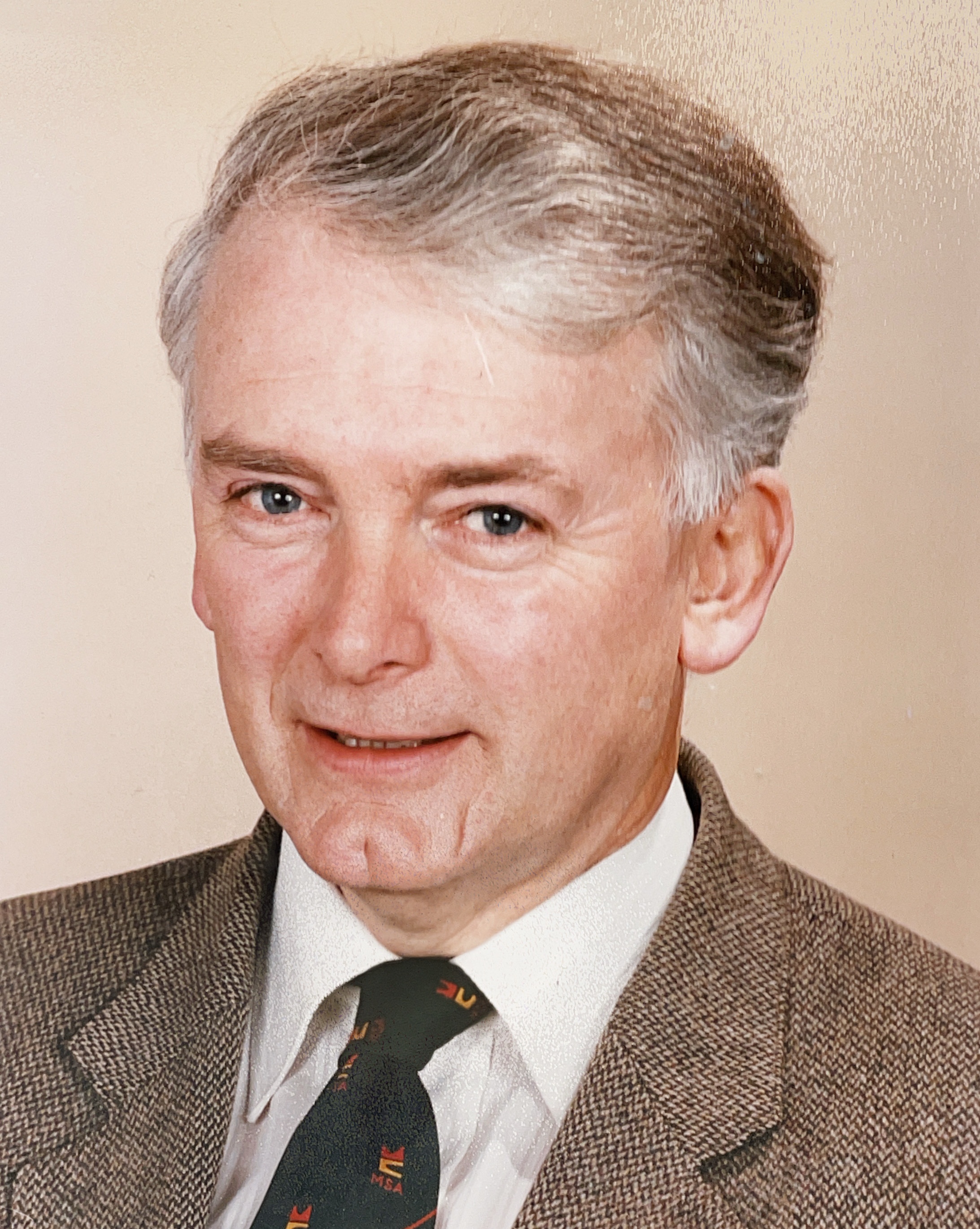
Throughout his years with the programme, he was a passionate advocate for ensuring that students developed a solid understanding of both engineering practice and theory.
He placed particular emphasis on practical skills and workshop awareness, making sure that graduates understood topics such as the correct use of fasteners and the proper operation of a torque wrench.
Each new intake was famously challenged to explain the difference between a planer and a shaper - an exercise that reflected his belief that engineers should be familiar with the tools, processes, and machinery that underpin their profession.
Building a new kind of course
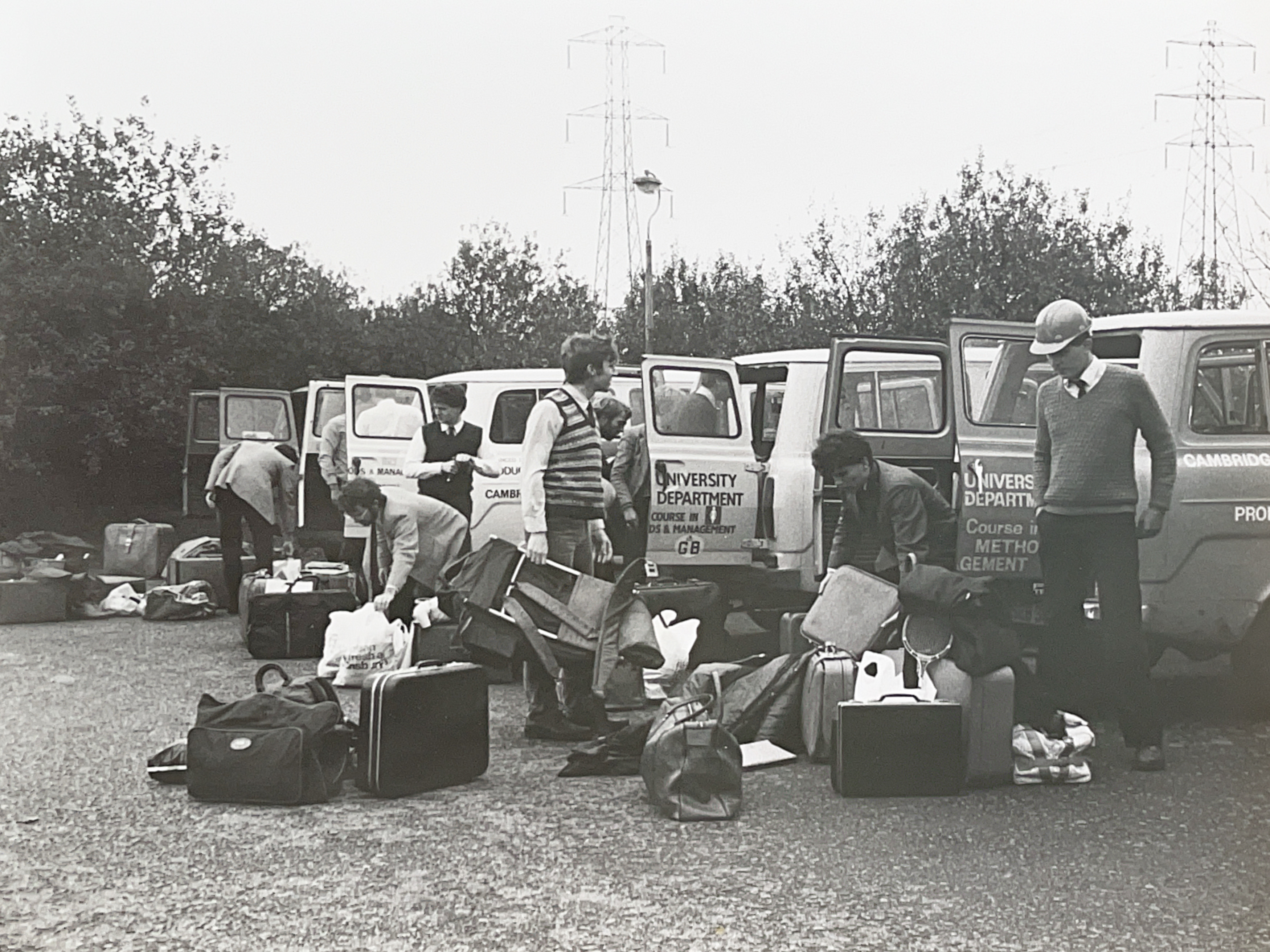
It is difficult to overstate Mike's influence on the development of the course. For many alumni, he embodied the distinctive philosophy that would make ACPMM unique. His vision of a course where 75% of the time was spent on the shop floor, with 12% on technical lectures and 13% on management, was radically different from anything existing in universities at the time and posed formidable logistical challenges involving companies, minibuses and B&Bs.
It required an extraordinary network of partner companies, extensive travel arrangements and countless hours of organisation. Yet it established many of the characteristics that alumni would come to recognise as hallmarks of the course: practical learning, industrial immersion and close links with industry.
Mike’s efforts to address challenges and navigate the complexities of financing and University politics over the following three decades helped establish a strong foundation for what would become today’s successful course, shaping manufacturing engineering education at Cambridge for generations.
ACPMM: A radical experiment in engineering education (1966–1988)
Learning through industry
The Advanced Course in Production Methods and Management (ACPMM) welcomed its first cohort in September 1966. Twelve graduates, sponsored by nine companies, embarked on a programme unlike any other in the UK.
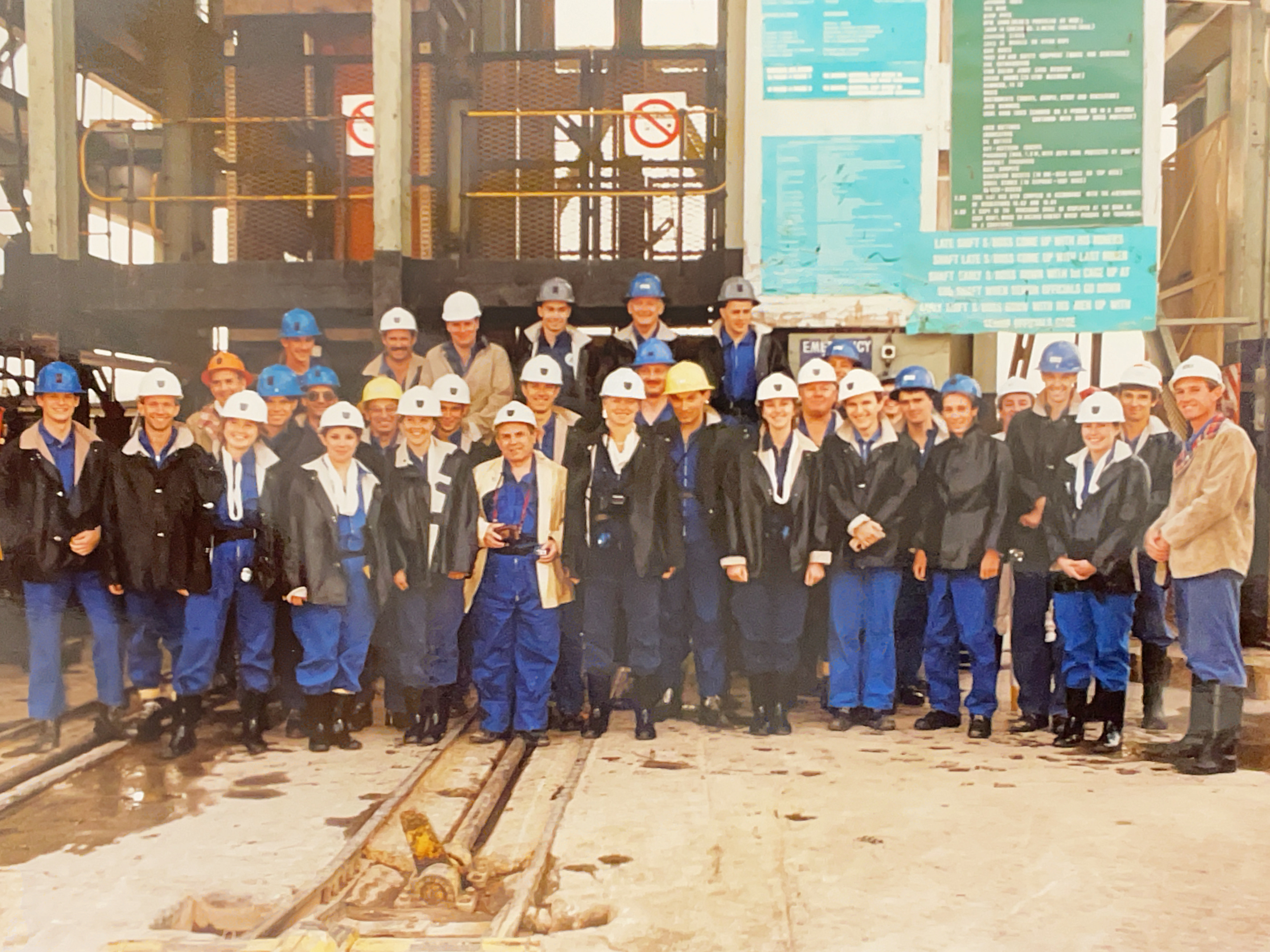
From the beginning, ACPMM was designed around industrial experience rather than classroom teaching. Participants moved between companies across the country, undertaking projects and gaining first-hand exposure to manufacturing practice. For many alumni, these placements, company visits and the famous European Tour became defining memories of their year on the course. The programme was intensive, with only short periods spent in Cambridge and very limited vacation time.
After the first two years, cohort sizes typically ranged from seven to twelve participants. However, when Cohort 9 (C9) grew to 17 members, Mike realised he needed additional support. Fortunately, he met David Dawson of Lancaster University, whose industrial background and commitment to practical, experience-based education closely matched his own. Although ACPMM was a University of Cambridge programme, it had no permanent base, with participants spending most of their time in industry. Having a northern outpost at Lancaster not only strengthened the programme but also helped ease the considerable travel demands placed on both staff and course members.
.jpg)
The first year of ACPMM
Building the ACPMM team
In 1976 (C10), Mike Sharman was ready for a well-deserved sabbatical and had a chance meeting with Mike Gregory, a graduate from C4 who had gone to work for Webster and Bennett, a well-known machine tool maker. Mike Gregory then took over during Mike Sharman’s sabbatical and remained for a further year. In the decades that followed, Mike Gregory founded the Production Engineering Tripos (later the Manufacturing Engineering Tripos), established major research groups and the Institute for Manufacturing, and played a pivotal role in transforming manufacturing into one of Cambridge’s most influential academic and industrial strengths.
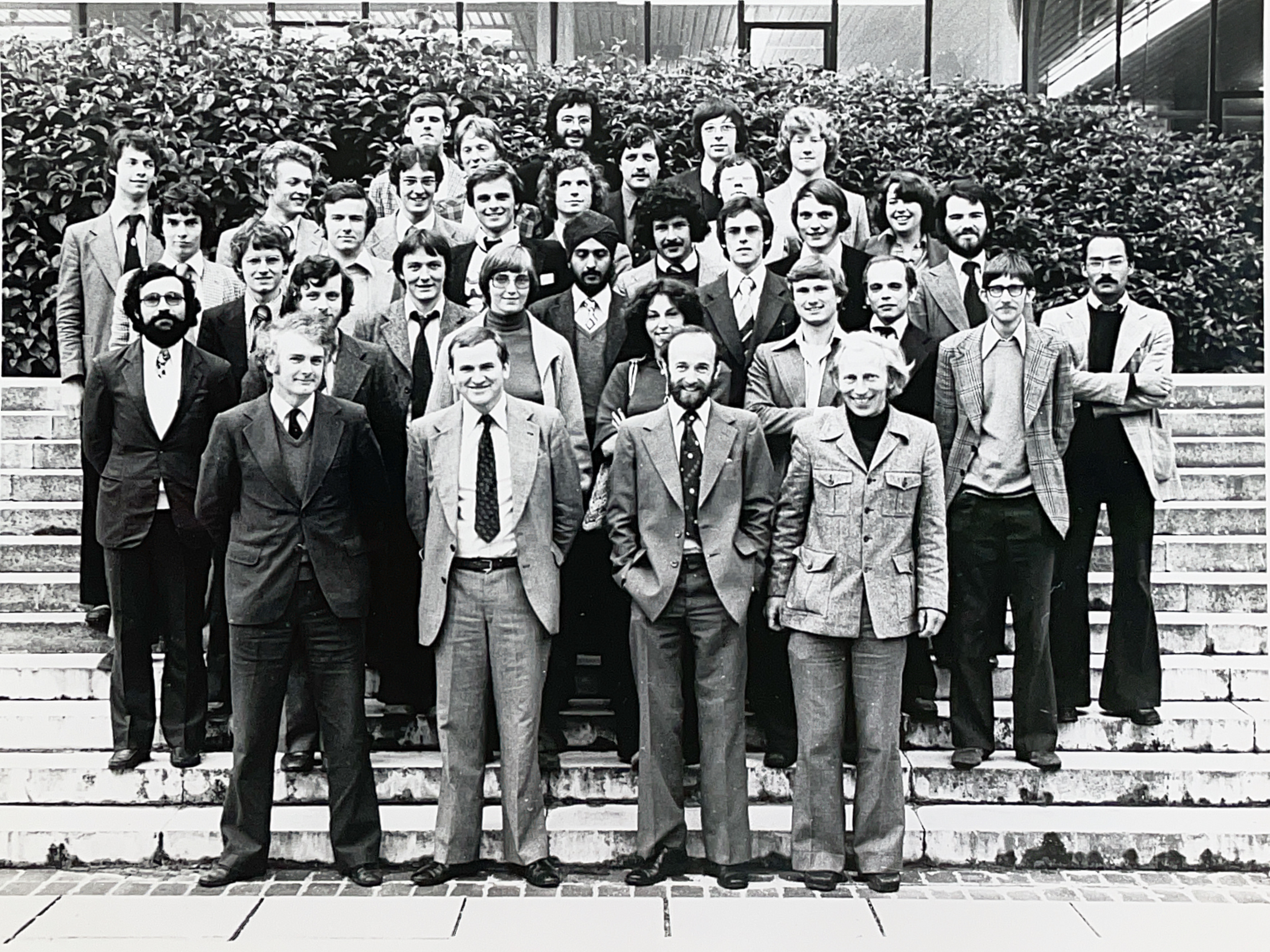
Mike Sharman (front left), Mike Greogry (front 2nd from right) and John Gatiss (front right)
The following year, the arrangement with David Dawson at Lancaster University was formalised, with central student funds shared on a one-third, two-thirds basis, and the intake rose to 33. A new member of staff was recruited to help in Cambridge. John Gatiss was a Cambridge graduate who had started his career in the design of heavy electrical equipment but was currently working on scientific instruments at Pye Unicam.
With an increasing number of staff and course members, managing the workload remained problematic, and a proposal was made to run the course with 1 full-time tutor and 4 half-time tutors at Cambridge, and 2 half-time tutors at Lancaster. The rationale was that the ACPMM workload was concentrated in certain short peak periods, but it would also enable the Tutors to remain engaged in their professional activities. It would also enable the Course to secure staff funding through industry secondments. John then transferred to half-time while working for a design consultancy.
Other companies that were willing to second staff were Cadbury’s, Rio Tinto Zinc and British Aerospace. The second Cadbury Fellow, David Clode, transferred to permanent staff. David was a chemist who had started his career as an academic before transferring to become a research chemist at Cadbury Schweppes. He stayed with the course for 20 years, and, as well as picking up a lot of manufacturing knowledge, shouldered the burdens of recruitment and the minibuses.
ACDMM: Growth, recognition and reinvention
From experimental course to national programme
In 1988, ACDMM was awarded £100,000 by the University Grants Committee, which led the University to formally recognise the course by awarding a Postgraduate Certificate in Design, Manufacture and Management and to underwrite 3 full-time academic posts, initially held by Mike Sharman, John Gatiss and David Clode. Lancaster University underwrote one full-time post held by Gary Lightfoot, and by 1990, the number of graduates had risen to 43.
The two-stream expansion
A bid was made to the Gatsby Foundation in 1991 to expand the Course to two streams of 36 each. This was based on Gatsby providing a £1 million pump-priming grant, EPSRC providing Advanced Studentships, and the University funding staff posts through the student block grants.
Another University, Durham, was brought into the partnership, and a two-stream course started in 1992. The larger Course, Red Stream, started in late August, while the smaller Course, Green Stream, started before Christmas.
To staff the expansion, another former course member, seconded by Rio Tinto, was sponsored by Gatsby. At Cambridge, two new staff members were recruited: Tom Ridgman and Keith Collins. At Lancaster, Andy Shaw joined the team, with Matt Jagger seconded by British Aerospace, while Durham University seconded John Garside to the course.
Meanwhile, John Gatiss took over from Mike Sharman as Course Director, with Keith Collins leading the Red Stream and Alison Cooke the Green Stream. Each course had its own administrator under Margaret Curley's supervision.
Adapting to a new funding landscape
This expansion was short-lived: in 1996 (Course 31), the EPSRC did not expand grants and the block-funding mechanisms for universities changed radically, causing the amount of money allocated to ACDMM to be halved. This caused Lancaster and Durham to withdraw from the partnership, leaving Cambridge running a single course of 53. With the future funding uncertain, Mike Sharman retired from his university post after 29 years, although he continued to support projects for another 8 years. John Gatiss handed over the Course Directorship to Tom Ridgman, and Andy Shaw transferred from Lancaster to Cambridge.
To fill the gaps in project support (each graduate was undertaking 9 projects at that time), senior retired industrialists were brought in as external industrial Tutors, the first group being David Heard, Royden Hales and Nigel Wallace.
Industrial Systems, Manufacture and Management (ISMM)
Modernising the course experience
By 2002, the course was facing threats on several fronts. The government was reducing undergraduate funding and had a policy to phase out postgraduate grants. Meanwhile, engineering graduates were leaving university with increasing levels of debt and, given the strong job market, had little financial incentive to continue into postgraduate education.
Simon Pattinson had been brought on board in 1999 to explore whether significant industrial sponsorship was viable, but large UK multinationals with centralised training and development were being broken down into much smaller autonomous business units without the budgets to support sponsorships. After evaluating a range of options, the preferred approach was to convert the course into a more conventional master’s degree while retaining as much of its industrial engagement and experiential learning as possible.
The University’s early retirement policy meant that John Gatiss’s post could not be filled until 2002, when the post was offered to Bruno Laurent, the first career academic to be appointed to ACDMM. Bruno made a great contribution to the course before he sadly passed away in 2005, and the lectureship was then held by Yongjiang Shi.
Becoming a master's degree
In 2004, the course was upgraded to a full MPhil. This required some changes to the structure, with fewer projects and a 12-week, more conventional master’s dissertation. This change caused some consternation among past graduates and staff, but it got the course out of an untenable situation and successfully preserved the principles and traditions of the course for future generations.
The 2004 course began with 40 students from around the world. As predicted, many high-calibre UK engineering graduates were either unable or unwilling to undertake master's study, but the course was oversubscribed with applicants and recruited students of around 20 different nationalities.
In 2005, a major contract was won to set up a new course at a new University in Trinidad and Tobago (UTT); the course was 2/3 ISMM and 1/3 Entrepreneurship, with the objective of preparing graduates to enter a competition for business start-up funds. To support this contract, Tom Ridgman went part-time to set up the UTT Course, and Simon Pattinson took over as Course Director. Derek Ford, who had been working for many years in IfM Engage but occasionally giving lectures and project support to the course, joined as a part-time industrial tutor. The pool of industrial tutors was expanded to cover the project support.
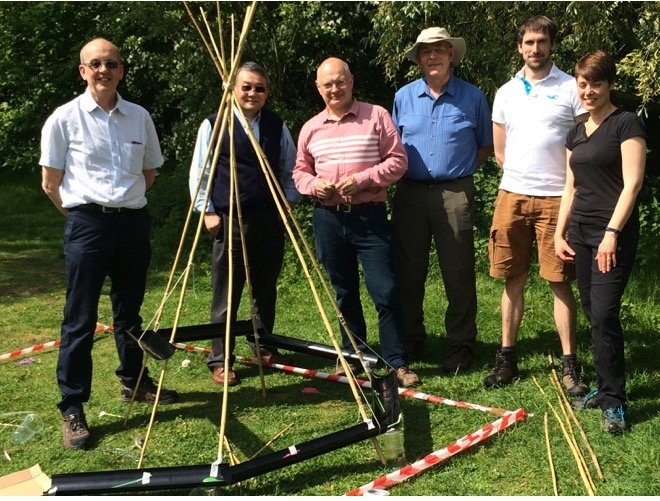
From left: Tom Ridgman, Yongjiang Shi, Simon Pattinson, David Schwarz, Phil Catton, Vanessa McNiven
Tom Ridgman took over as Course Director again in 2014 and a major review of the course was undertaken. Since the course was founded, there have been many changes in the University, including the formal adoption of the course by the Engineering Department, the establishment of MET, the establishment of the Judge Business School, the establishment of the Institute for Manufacturing and the development of research in many areas. ISMM, however, was still an independent unit with 3 University Lectureships, its own admin staff, and a budget for industrial tutors and speakers.
At the macro level, it was financially profitable to the University, but at the Department level, since most of the Department's funding depended on research performance to which ISMM staff did not contribute, it was not very financially attractive.
In 2017 James Moultrie took over as Academic Director and Florian Urmetzer as Operations Director, and the course was reconfigured so that the graduates were taught in the university term times and could take advantage of broader college access, as well as join wider university activities like sports.
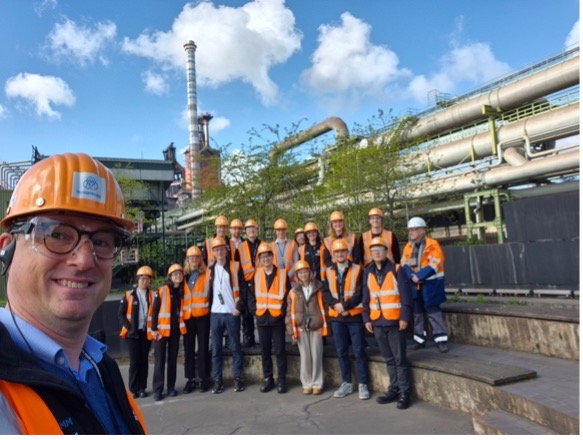
Florian Urmetzer (front left) with some of C60
In keeping with tradition, there were five projects: three industrial projects undertaken during the University vacation periods, one industrial project conducted one day per week during Lent Term, and a further project integrated into the taught programme. Tom Ridgman retired in 2018 after 23 years with the course, and Florian Urmetzer took over as Course Director joined later by Vanessa McNiven as Executive Course Director.
Preserving hands-on learning in a digital age
During COVID, industrial visits and projects as we know them came to a stop, but ever resourceful and willing to get involved, ISMM students became heavily involved in supporting the local hospital. Leading to a silver medal from the Royal Academy of Engineering and recognition by Addenbrooke’s Hospital, students worked on streamlining COVID testing, PPE production and other projects.
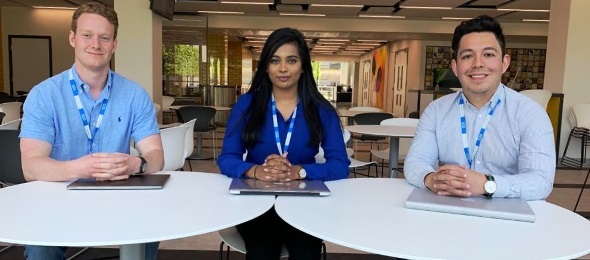
Left to right: Jack Levy, Fathima Nisha Begum Samad and David Cordova Jimenez, who received awards for their social impact.
Post-COVID, the course continues to keep pace with a changing world and student interests. The New Business Development module has been re-designed to support the development of entrepreneurial competences, as many ISMM graduates go on to build their own businesses or work in high-potential start-ups. ISMM also became the first course in the Engineering Department to allow students to use AI backed by a clear usage policy which has since been adopted by other programmes.
ISMM graduates go into roles all over the world and across many industries, entering manufacturing and operations, consulting, finance and starting their own businesses. The skills, experience, strategic thinking and confidence built on the course are greatly needed, and our graduates continue to be highly sought after. While automation and new technologies have transformed many aspects of the course over the years, our strength continues to lie in our exceptional students, hands-on company projects, and visits that underpin a world-class practical education.
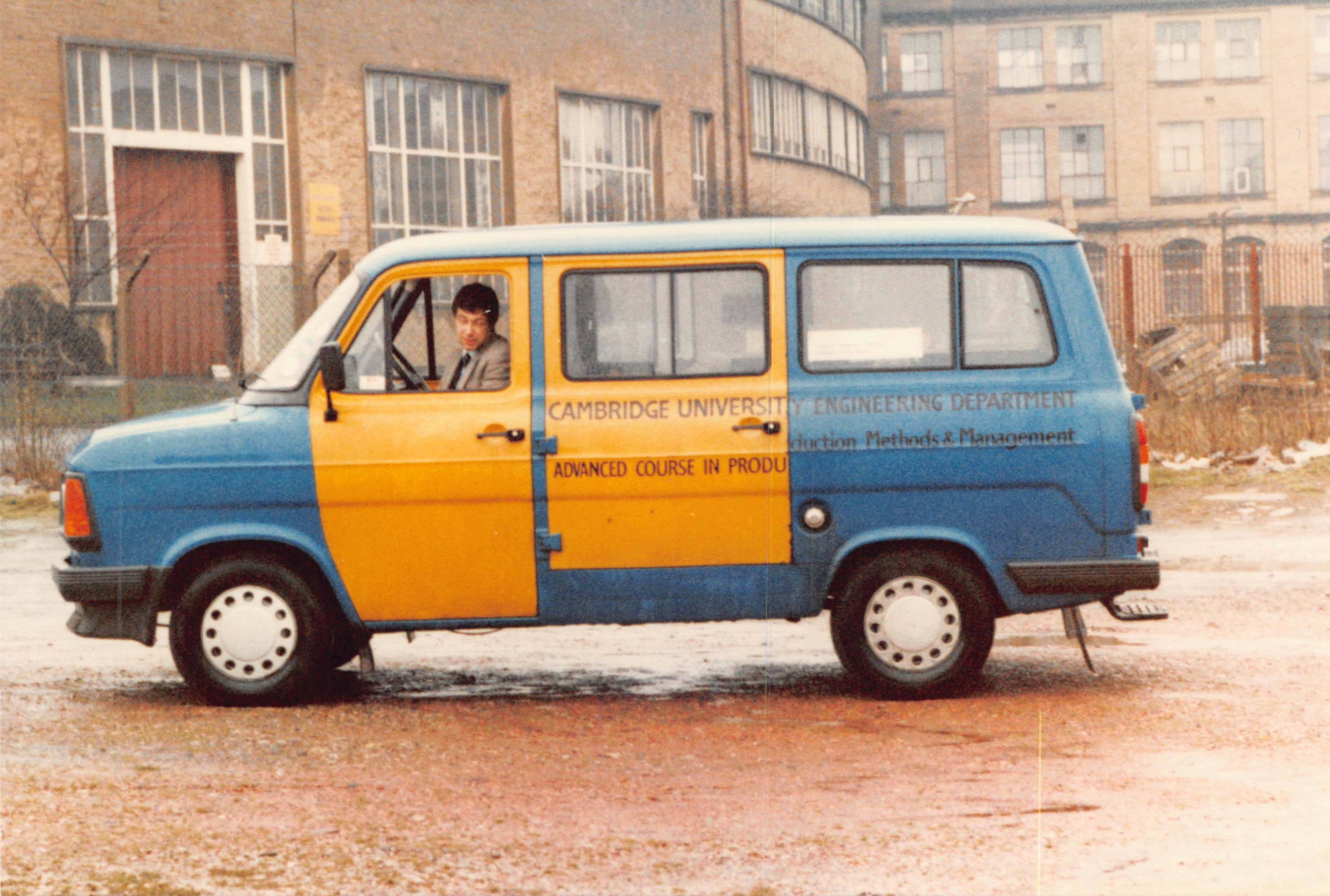
ACPMM minibus with miss-matched doors, 1984. Image credit: DJ Hamblin-Brown
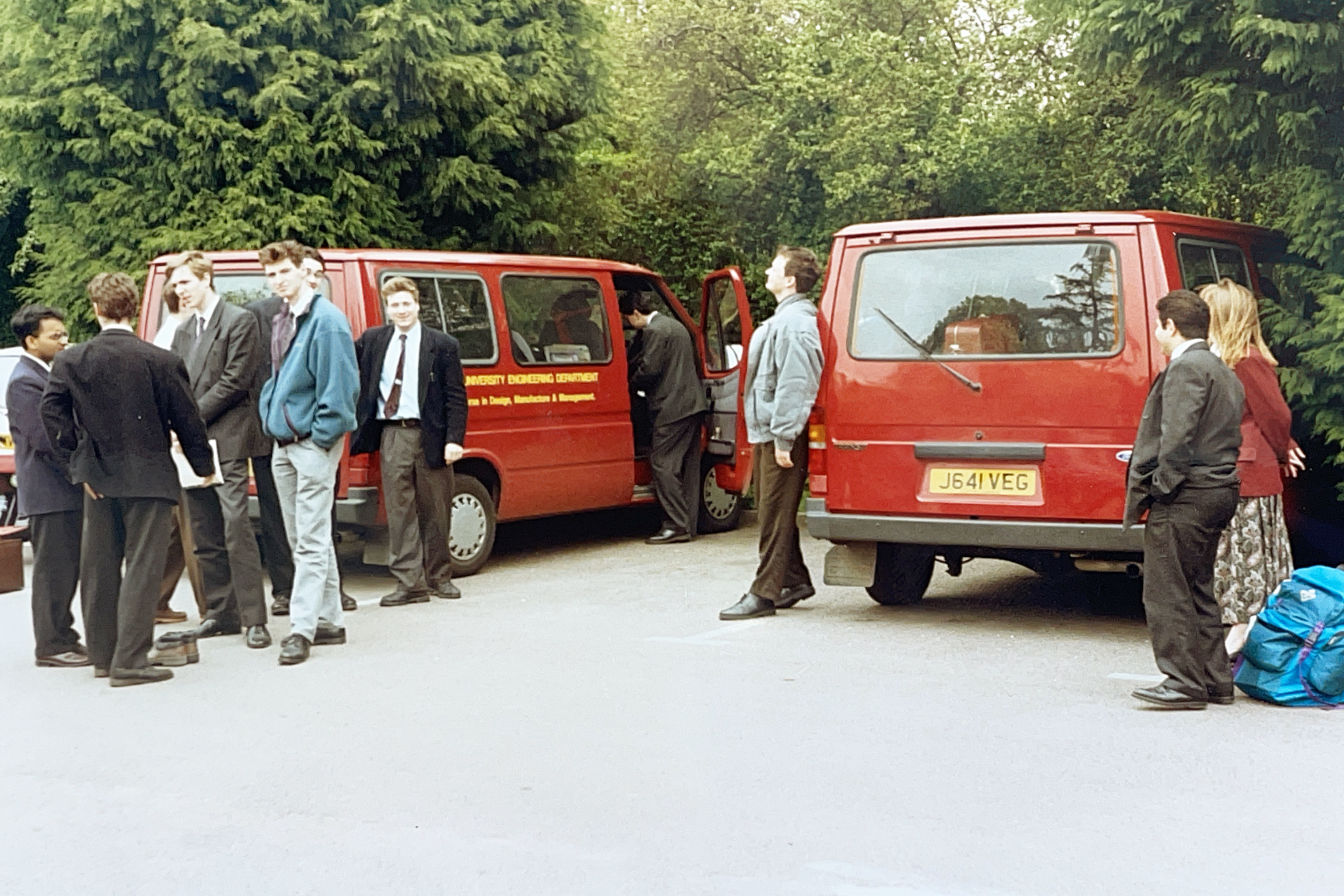
As we approach the end of the 60-year overview, no account of the history of the programme would be complete with acknowledging the vital role that the course minibuses have played from day one.
Providing transport, freedom, comfort and self-reliance, the buses have been the focal point of the ACPMM/ACDMM/ISMM experience, and we remain proud to send a fleet of skilled minibus drivers out into the world each year!
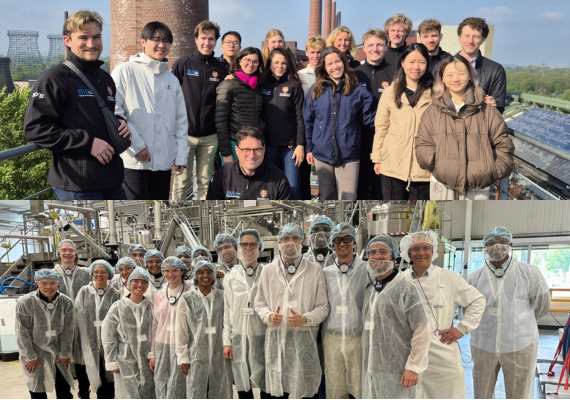
C60 on study tour in 2026
Join us in commemorating 60 years of industrial impact, nearly 1900 graduates, and help us build the next chapter.
Make a gift to the IfM 60th Anniversary fund