

International manufacturing mobility
Aims
- develop an audit procedure to compare the manufacturing capability of plants between which a product transfer is being considered
- design a mapping technique which will allow conditions for transfer and conditions for receipt of a product for manufacture to be established and reconciled
- produce a project management framework which can be tailored to the particular circumstances of each international interplant transfer
Background
In the face of growing international competition, traditional patterns of home manufacture and export are increasingly being replaced by international networks of manufacturing capacity. Even if individual firms are not international organisations, they need to be able to understand and operate within the global networks established by their customers.
Assessment of the capabilities of potential transferring and receiving sites, and the ability to swiftly and reliably move products between them - i.e. manufacturing mobility - is fundamental to successful operation of the emerging networks.
The manufacturing transfer process (Diagram below)
Traditionally, the strategic assessment of potential manufacturing transfers concentrates on financial and legal (contractual) issues alone. This analysis is frequently static and based only on a limited range of variables, such as the cost of a single factor. Considerably less emphasis is placed initially on the alignment between potential partnersí manufacturing capabilities, or the identification of possible difficulties arising from the technological and manufacturing systems in use. In addition, subtle, though no less important, social, political and cultural aspects are usually not recognised in the early stages of a project. As a result, product transfers are frequently more troublesome, time-consuming and costly than originally planned.

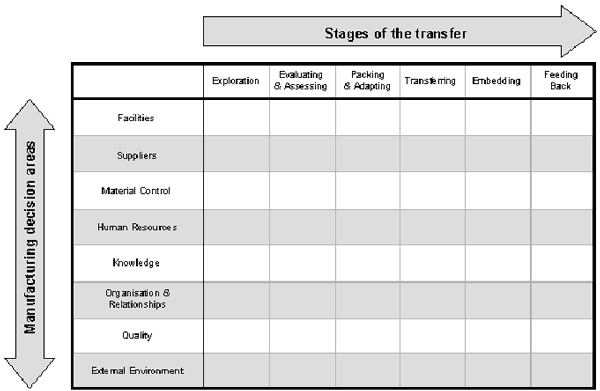
A software package has been developed to provide a tool for capturing knowledge relating to the international transfer of production technology. The diagram above illustrates the structure used to navigate within the software package.
Outcomes
- Two Workbooks 'Manufacturing Mobility' and 'Fitness for Transfer' have been published. They provide a structured process to help managers transfer production technology effectively and efficiently
- A software package has been developed for capturing knowledge relating to the international transfers of production technology
Researchers
Tim Minshall
Andrew Steele