

Researchers develop explainable AI that can reason, decide and act in manufacturing environments
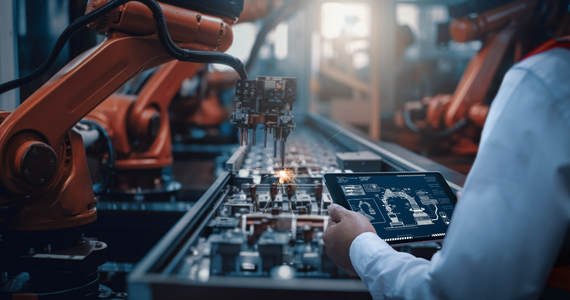
Researchers from the Computer-Aided Manufacturing group at the Institute for Manufacturing (IfM) have developed a new artificial intelligence framework that combines machine learning, engineering knowledge and physical reasoning to enable more reliable and transparent autonomous manufacturing.
Published in Nature Communications, the study introduces Control and Interpretation of Production via Hybrid Expertise and Reasoning (CIPHER), an AI system that can identify production problems, explain their causes and recommend corrective actions, helping bring more capable and trustworthy AI to factory environments.
The research addresses a longstanding challenge in industrial AI. While large foundation models have demonstrated impressive capabilities in language and image understanding, they often struggle to deliver the quantitative precision required for engineering applications. At the same time, conventional manufacturing AI systems typically depend on large volumes of labelled data and can struggle to adapt when conditions change.
CIPHER takes a different approach. Rather than relying on a single AI model, CIPHER combines specialist process expertise with large language models and retrieval-based reasoning grounded in manufacturing knowledge and process physics, enabling it to interpret images and text, generate machine instructions, identify process anomalies and recommend corrective actions. Importantly, it was able to do this even when faced with situations it had not encountered before.
Dr Sebastian Pattinson, Head of the Computer-Aided Manufacturing group and co-author on the paper, says, “The key idea is that we shouldn’t expect a single, general-purpose AI model to be good at every part of an engineering problem. In manufacturing, you need quantitative precision as well as the ability to reason about unfamiliar situations. CIPHER brings those two capabilities together via specialist models that make precise measurements, while the larger AI system uses engineering knowledge and physics to work out what those measurements mean in context and what to do next”
The system's ability to explain how it reaches its conclusions could help address concerns about the use of AI in manufacturing.
“In a factory, it isn’t always enough for an AI to say ‘change this parameter’, especially before people have learned to trust the system.” Sebastian comments, “CIPHER can connect what it sees to a physical explanation and then to a corrective action. That makes its decisions easier to interrogate, and it could also be useful for training, helping operators understand why a problem occurred and how it might be corrected.”
The researchers also demonstrated that CIPHER could move beyond process control and generate manufacturing instructions directly from natural-language requests. In one set of experiments, users described an object in plain language and the system generated the manufacturing instructions needed to produce it.
“What is interesting about natural language here is that it gives people a direct way to express what they want to achieve,” says Sebastian. “The AI can then translate that intent into something the manufacturing system can actually do.”
This ability to combine accurate numerical outputs with high-level engineering logic ensures the AI remains quantitatively exact yet creatively adaptable to new manufacturing problems.
You cannot realistically collect training data for every situation a manufacturing system will encounter.” Sebastian says, “For manufacturing, the goal shouldn’t just be AI that has seen more examples. It should be AI that has better ways to reason when it encounters something new.”
The researchers anticipate the framework will be able to support future applications in autonomous production, process optimisation and advanced manufacturing systems, while also providing a foundation for more trustworthy and explainable industrial AI.
Read the full paper, which is available open access, to find out more: https://www.nature.com/articles/s41467-026-72378-9