
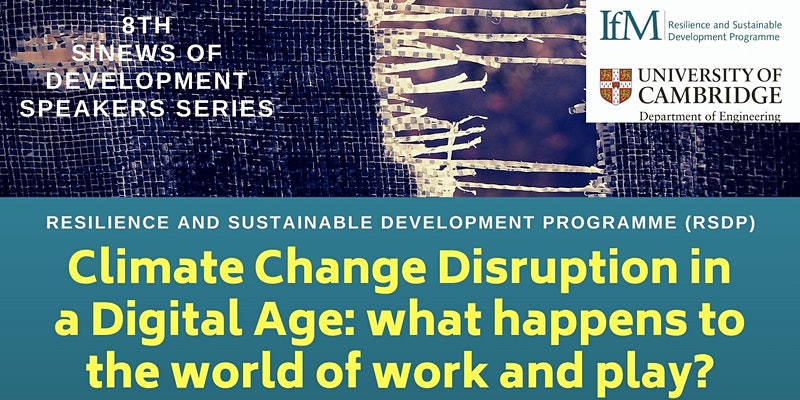
Climate change disruption in a digital age
What happens to the world of work and play?
We are in the midst of a Sustainability tipping point, exemplified by Larry Fink, Blackrock’s CEO, whose recent annual letter starts by saying “There is no company whose business model won’t be profoundly affected by the transition to a net zero economy”. The future of work will be different.
Simultaneously we are in the midst of a digital revolution that affects the way we shop, the way we entertain, and less obviously, the way we do business, with the latter called ‘Industry 4.0’ to mark it as the 4th great business revolution.
This Sinews lecture series will try to bring these two great disruptions together, commenting on how they will combine and shape each other, and how that will shape the world of future work and of future play. What will jobs look like, for the ‘knowledge worker’ as well as the sewing machine operator in a low-cost factory? How do governments, businesses and young people prepare for these changes? We will explore this topic through the lenses of our excellent speakers.
Speakers
Rt Hon Greg Clark MP, Secretary of State for Business, Energy and Industrial Strategy, UK
The Rt Hon Greg Clark was Secretary of State for Business, Energy and Industrial Strategy from July 2016 to July 2019. He was elected Conservative MP for Royal Tunbridge Wells in 2005. Born in Middlesbrough, Greg studied economics at Cambridge before earning his PhD from the London School of Economics. Greg was Director of Policy for the Conservative Party from March 2001 for 3 successive leaders - William Hague, Iain Duncan Smith and Michael Howard - before being elected as an MP in 2005. To find out more click here.
Prof Steve Evans, Director of Research in Industrial Sustainability, University of Cambridge, UK
Steve Evans spent 12 years in industry, rising to become Engineering Systems Manager at Martin-Baker Engineering, the world leading manufacturer of ejection seats. His industrial experience led to an emphasis on improving engineering performance and provided an excellent grounding for tackling complex, real-life problems. Steve has over 20 years of academic experience which includes working collaboratively with leading industrial and academic institutions from around the globe. To find out more click here
Larry Elliott, Economics Editor, The Guardian
Larry Elliott is the Guardian’s economics editor and has been with the paper since 1998. He is a prominent speaker on the UK & global economies, trade and development and the interface between economics and the environment. He is widely recognised as one of Europe’s leading futurists on trends within the global economy. Larry Elliot is a graduate of Fitzwilliam College, Cambridge. He was part of the group that put together the proposal for a “Green New Deal”, published by the New Economics Foundation in 2008. To find out more click here
Dr Natalie Jones, Postdoctoral Research Associate, Centre for the Study of Existential Risk, University of Cambridge, UK
Natalie works on how global injustice and inequality can potentially contribute to existential risk, with a particular interest in climate change. She focuses on accountability and procedural justice in global governance. She is also a Staff Writer for the Earth Negotiations Bulletin at the International Institute for Sustainable Development, a Research Assistant at the Lauterpacht Centre for International Law, and a judges' clerk at the High Court of New Zealand. She hold an LLM in international law from the University of Cambridge, and an LLB(Hons) and BSc in physics from the University of Canterbury. To find out more click here
Chair
Rt Honourable Andrew Mitchell MP
Andrew is the Member of Parliament for Sutton Coldfield. Mr. Mitchell was Secretary of State for International Development in the British Government from May 2010 until he became Government Chief Whip in September 2012. He was a member of the National Security Council in Britain and a Governor of the World Bank between 2010 and 2012. He was appointed to the Privy Council in 2010. Prior to joining the cabinet in 2010, he also held numerous junior positions in Government (1992-1997) and in opposition (2003-2010). He was a Director of Lazard Asia and Lazard India as well as of Lazard London. He is a Senior Fellow of the Resilience and Sustainable Development Programme (RSDP) at the University of Cambridge; a Visiting Fellow at Harvard University and at the School of International Studies of Peking University; and an Honorary Professor in the School of the Social Sciences for the University of Birmingham. To find out more click here.
Director
Dr Nazia M Habib, FRSA, Founding Director, Resilience and Sustainable Development Programme (RSDP), University of Cambridge
The founding director of RSDP, Dr Nazia M Habib, FRSA trained as a political economist from the University of Cambridge. She specialises in applied resilience and sustainability scholarship. She has advised over 20 countries on a wider variety of topics related to sustainable development and public policy upgrading. She holds multiple fellowships including the prestigious World Economic Forum (WEF), Sustainability Science fellowship at Harvard, and MIT and Newton Fellowship to name a few. Prior to founding RSDP, she was one of the founding university lecturers for the MPhil in Public Policy degree programme at Cambridge. Her book Biofuels, Food security, and Developing economies (2016) was ranked among the top three highly influential by Food Tank. At Cambridge, she received the Claydon Prize for outstanding PhDs in Economics. To find out more click here
For further information please contact:
Dr Nazia Mintz Habib
Event Timings
Date: 11 March 2021